Goal Programming and Monte Carlo Simulation for Optimizing Inbound Scheduling in Resource-Constrained Warehouses
Main Article Content
Keywords
Goal Programming, Monte-Carlo Simulation, Time Efficiency, inbound scheduling, SMEs
Abstract
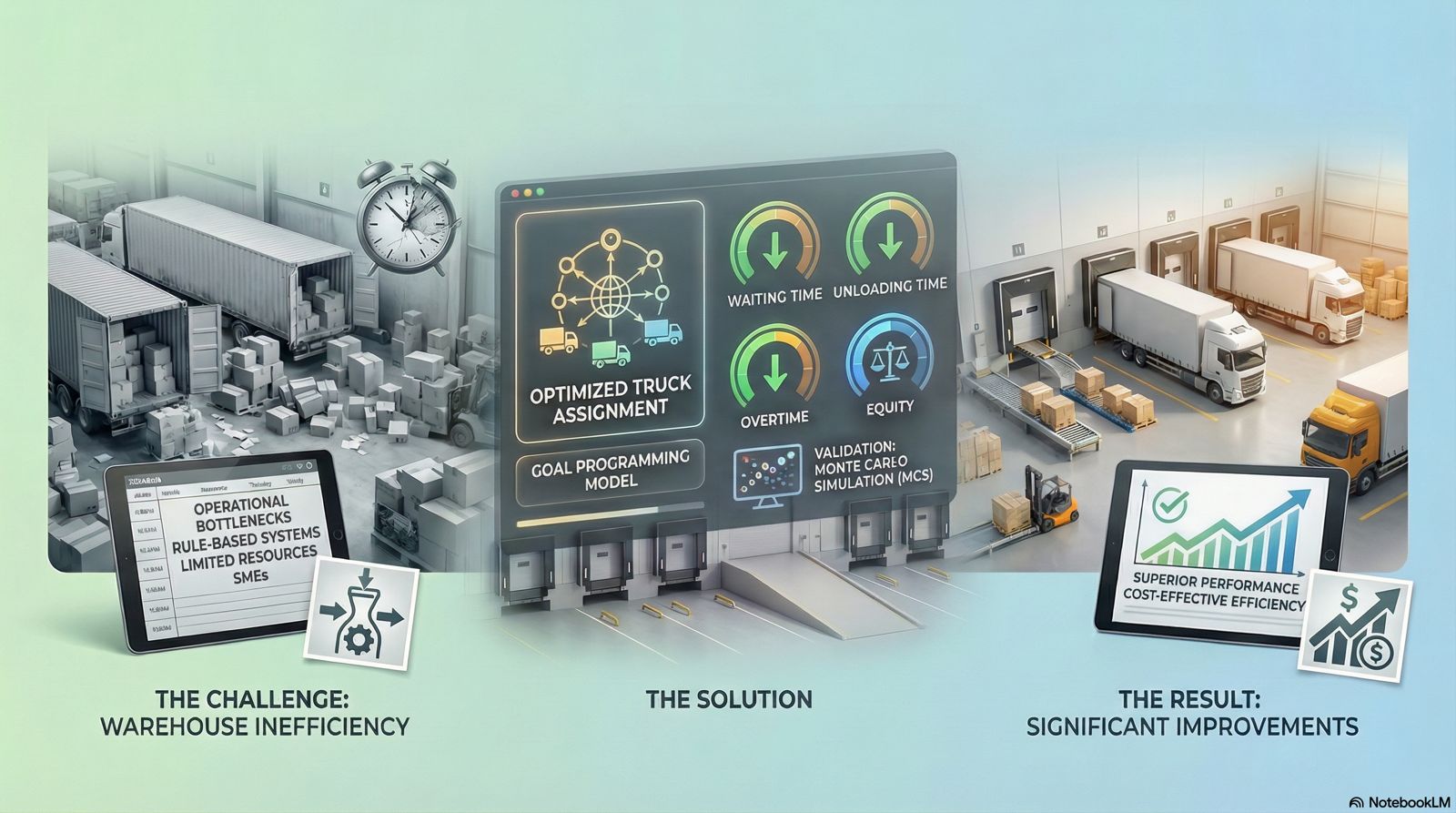
Resource efficiency lies at the heart of logistics performance, with unloading operations in storage facilities serving as a critical determinant of overall productivity. In less developed regions, the widespread reliance on basic rules-based systems such as FIFO often proves inadequate for handling operational complexities, leading to bottlenecks and inefficiencies. Small and medium-sized enterprises (SMEs), constrained by limited resources, are compelled to optimize existing infrastructure rather than invest in costly upgrades. To address this challenge, the present study introduces a goal-oriented programming model designed to assign trucks to loading docks within specific time slots, thereby enhancing time efficiency. The model evaluates performance across four key metrics: waiting time, loading time, overtime, and equity. By leveraging goal programming, numerical prioritization of these objectives becomes possible, enabling flexible adjustments to meet operational needs. Furthermore, Monte Carlo simulation (MCS) is employed to incorporate variability into the dataset and assess model robustness under real-world uncertainty. Experimental results reveal that the proposed approach consistently outperforms traditional systems, delivering significant improvements in time efficiency. These findings highlight the potential of goal programming as a practical solution for planning in resource-constrained environments. The resulting model offers an adaptive, reliable framework that warehouse managers can implement without incurring substantial infrastructure costs.
Downloads
References
[2] Hamontree, S. Prompakdee, and J. Koiwanit, “Resource scheduling problem in distribution center,” IOP Conference Series Materials Science and Engineering, vol. 639, no. 1, p. 012017, Oct. 2019, doi: 10.1088/1757-899x/639/1/012017.
[3] Z. Lin, “Big Data Analytics in Supply Chain Optimization and Risk Management: A case study of Amazon,” SHS Web of Conferences, vol. 208, p. 04024, Jan. 2024, doi: 10.1051/shsconf/202420804024.
[4] J. Yao, “Supply chain scheduling optimisation in mass customisation based on dynamic profit preference and application case study,” Production Planning & Control, vol. 22, no. 7, pp. 690–707, Jan. 2011, doi: 10.1080/09537287.2010.537577.
[5] H. Liu, F. Wang, J. Zhao, J. Yang, C. Tan, and L. Zhou, “Performance analysis of picking path strategies in Chevron Layout Warehouse,” Mathematics, vol. 10, no. 3, p. 395, Jan. 2022, doi: 10.3390/math10030395.
[6] Journal, “Reviewing the role of Mathematical Optimization in Operations Research: Algorithms, applications, and challenges,” INTERANTIONAL JOURNAL OF SCIENTIFIC RESEARCH IN ENGINEERING AND MANAGEMENT, vol. 08, no. 02, pp. 1–11, Feb. 2024, doi: 10.55041/ijsrem28578.
[7] Aktas and M. Kabak, “A goal programming model for grid-connected hybrid energy system operations,” SN Applied Sciences, vol. 2, no. 1, Dec. 2019, doi: 10.1007/s42452-019-1878-1.
[8] M. F. Kahraman, H. Bilge, and S. Öztürk, “Uncertainty analysis of milling parameters using Monte Carlo simulation, the Taguchi optimization method and data-driven modeling,” Materials Testing, vol. 61, no. 5, pp. 477–483, Apr. 2019, doi: 10.3139/120.111344.
[9] P. Centobelli, G. Converso, T. Murino, and L. C. Santillo, “Flow shop scheduling algorithm to optimize warehouse activities,” International Journal of Industrial Engineering Computations, pp. 49–66, Aug. 2015, doi: 10.5267/j.ijiec.2015.8.001.
[10] Y. Wang, W. Liu, C. Wang, F. Fadzil, S. Lauria, and X. Liu, “A Novel Multi-Objective Optimization Approach with Flexible Operation Planning Strategy for Truck Scheduling,” International Journal of Network Dynamics and Intelligence, p. 100002, Jun. 2023, doi: 10.53941/ijndi.2023.100002.
[11] W. Yu, C. Ha, and S. Park, “A Hybrid Genetic Algorithm for Integrated Truck Scheduling and Product Routing on the Cross-Docking System with Multiple Receiving and Shipping Docks,” Mathematical Problems in Engineering, vol. 2021, pp. 1–17, Mar. 2021, doi: 10.1155/2021/2026834.
[12] H. M. Alakaş, T. Eren, A. Yelek, and E. H. Özder, “Goal programming models for high-speed train crew scheduling problem,” Soft Computing, vol. 28, no. 7–8, pp. 5921–5936, Dec. 2023, doi: 10.1007/s00500-023-09466-1.
[13] M. Sajid, H. Mittal, S. Pare, and M. Prasad, “Routing and scheduling optimization for UAV assisted delivery system: A hybrid approach,” Applied Soft Computing, vol. 126, p. 109225, Jul. 2022, doi: 10.1016/j.asoc.2022.109225.
[14] W. Y. Ha and Z.-P. Jiang, “Optimization of Cube storage warehouse scheduling using genetic algorithms,” 2022 IEEE 18th International Conference on Automation Science and Engineering (CASE), pp. 1–6, Aug. 2023, doi: 10.1109/case56687.2023.10260388.
[15] M. Kmiecik, “Creating a genetic algorithm for third-party logistics’ warehouse delivery scheduling via a large language model,” Journal of Modelling in Management, Jan. 2025, doi: 10.1108/jm2-06-2024-0192.
[16] F. Zeng, Y. Huang, J. Ding, X. Li, and Y. Liu, “Research on Scheduling Optimization Algorithm of Picking Job in Logistics Automated Warehouse Based on Chaotic Genetic Algorithm,” International Conference on Mechatronics, IoT and Industrial Informatics (ICMIII), pp. 320–324, Jun. 2023, doi: 10.1109/icmiii58949.2023.00067.
[17] W. O. Akerejola, E. U. Okpara, P. Ohikhena, and P. O. Emenike, “Availability of infrastructure and adoption of point of sales of selected small and medium enterprises (SMEs) in Lagos State, Nigeria,” International Journal of Academic Research in Business and Social Sciences, vol. 9, no. 1, Jan. 2019, doi: 10.6007/ijarbss/v9-i1/5370.
[18] L. Hongbo, K. A. Lucien, Y. K. Raphael, and A. A. Boris, “Contribution of Small Medium Enterprises (SMEs) to Economic Development: Comparative Study of China and Cote d’lvoire,” International Journal of Academic Research in Business and Social Sciences, vol. 8, no. 11, Dec. 2018, doi: 10.6007/ijarbss/v8-i11/5393.
[19] C. Wu, Y. Wu, Z. Li, and W. Zong, “A linear programming model for transportation planning in the arbitrary truck load strategy to supply products with unbalanced demand,” International Conference on Pure, Applied, and Computational Mathematics (PACM), p. 53, Jun. 2023, doi: 10.1117/12.2679309.
[20] H. B. Obaid, T. B. Trafalis, M. M. Abushaega, A. Altherwi, and A. Hamzi, “Optimizing dynamic evacuation using Mixed-Integer linear programming,” Mathematics, vol. 13, no. 1, p. 12, Dec. 2024, doi: 10.3390/math13010012.
[21] I. Kacem, D. La Torre, and H. Masri, “Preface: Recent advances in multiple objective optimization and goal programming,” Annals of Operations Research, vol. 296, no. 1–2, pp. 1–5, Dec. 2020, doi: 10.1007/s10479-020-03848-6.
[22] Ş. Gür, M. Pınarbaşı, H. M. Alakaş, and T. Eren, “Operating room scheduling with surgical team: a new approach with constraint programming and goal programming,” Central European Journal of Operations Research, vol. 31, no. 4, pp. 1061–1085, Dec. 2022, doi: 10.1007/s10100-022-00835-z.
[23] I. Kouroudis, M. Gößwein, and A. Gagliardi, “Utilizing Data-Driven optimization to automate the parametrization of kinetic Monte Carlo models,” The Journal of Physical Chemistry A, vol. 127, no. 28, pp. 5967–5978, Jul. 2023, doi: 10.1021/acs.jpca.3c02482.
[24] Y. Zeng, Y. Sun, T. Xu, and S. Su, “A reliability evaluation method for complex systems based on the editable GSPN and adaptive Monte Carlo simulation,” Systems Engineering, vol. 27, no. 3, pp. 520–531, Nov. 2023, doi: 10.1002/sys.21736.
[25] K. P. Freeman, J. R. Cook, and E. H. Hooijberg, “Introduction to statistical quality control,” Journal of the American Veterinary Medical Association, vol. 258, no. 7, pp. 733–739, Mar. 2021, doi: 10.2460/javma.258.7.733.
[26] PuLP, version 3.0.2, Python Package Index, 2023. [Online]. Available: https://pypi.org/project/PuLP. [Accessed: Date of Access].
[27] MongoDB, MongoDB Community Edition, MongoDB, Inc., [Online]. Available: https://www.mongodb.com/products/community.
Article Sidebar

Article Details

This work is licensed under a Creative Commons Attribution-NonCommercial-ShareAlike 4.0 International License.
Copyright Ownership
- Authors who publish their articles in Jurnal Optimasi Sistem Industri (JOSI) retain full copyright of their work.
- JOSI does not require authors to transfer their copyright to the journal or its publisher, Universitas Andalas. The authors grant JOSI a license for first publication.
All articles published in Jurnal Optimasi Sistem Industri (JOSI) are licensed under the Creative Commons Attribution-NonCommercial-ShareAlike 4.0 International (CC BY-NC-SA 4.0) license.
This means that users are free to:
- Share — copy and redistribute the material in any medium or format.
- Adapt — remix, transform, and build upon the material.
Under the following terms:
- Attribution (BY): You must give appropriate credit to the author(s) and JOSI as the original source of publication (including the article title, author(s) names, journal name, volume, issue, page numbers, year, and DOI), provide a link to the CC BY-NC-SA 4.0 license, and indicate if changes were made. You may do so in any reasonable manner, but not in any way that suggests the licensor endorses you or your use.
- NonCommercial (NC): You may not use the material for commercial purposes.
- ShareAlike (SA): If you remix, transform, or build upon the material, you must distribute your contributions under the same CC BY-NC-SA 4.0 license as the original.
A link to the full license text should also be provided: https://creativecommons.org/licenses/by-nc-sa/4.0/
Andreas Handojo, Petra Christian University
Andreas Handojo is an associate professor and head of field studies at the Department of Informatics in Petra Christian University, Indonesia. He received his Doctor of Industrial Engineering degree in Supply Chain and Logistics Management; and master’s degree in management of technology from the Sepuluh Nopember Institute of Technology, Indonesia. He achieved his bachelor’s degree in electrical engineering at Petra Christian University. His research interests are machine learning related to engineering and industrial application.
Tanti Octavia, Petra Christian University
Tanti Octavia is an associate professor specializing in Supply Chain and Inventory Management. She achieved a master's degree in industrial engineering and management from the Asian Institute of Technology, Thailand and a bachelor's degree in the industrial engineering department from Petra Christian University, Indonesia. She actively works in research and publishing, providing her expertise to help create effective operating methods across diverse sectors. Her research interests are industrial engineering related to supply chain and inventory management.
Demetrio F. Edryan, University of British Columbia
Demetrio Franklyn Edryan is an undergraduate student at the University of British Columbia, Canada majoring in computer science. He has an extensive background in mathematics and software engineering, with notable achievements in the mathematics national Olympiad. He is passionate about exploring analytical approaches that make use of technological advancements to solve problems in industry. His research interests are primarily on the field of data science and cybersecurity.