
Determining the Number of Stops and Recharging Time for Electric Vehicle Trips Using GIS and k-Means Clustering
Main Article Content
Keywords
electric vehicles, charging stations, k-means clustering, Geographic Information Systems , recharge time
Abstract
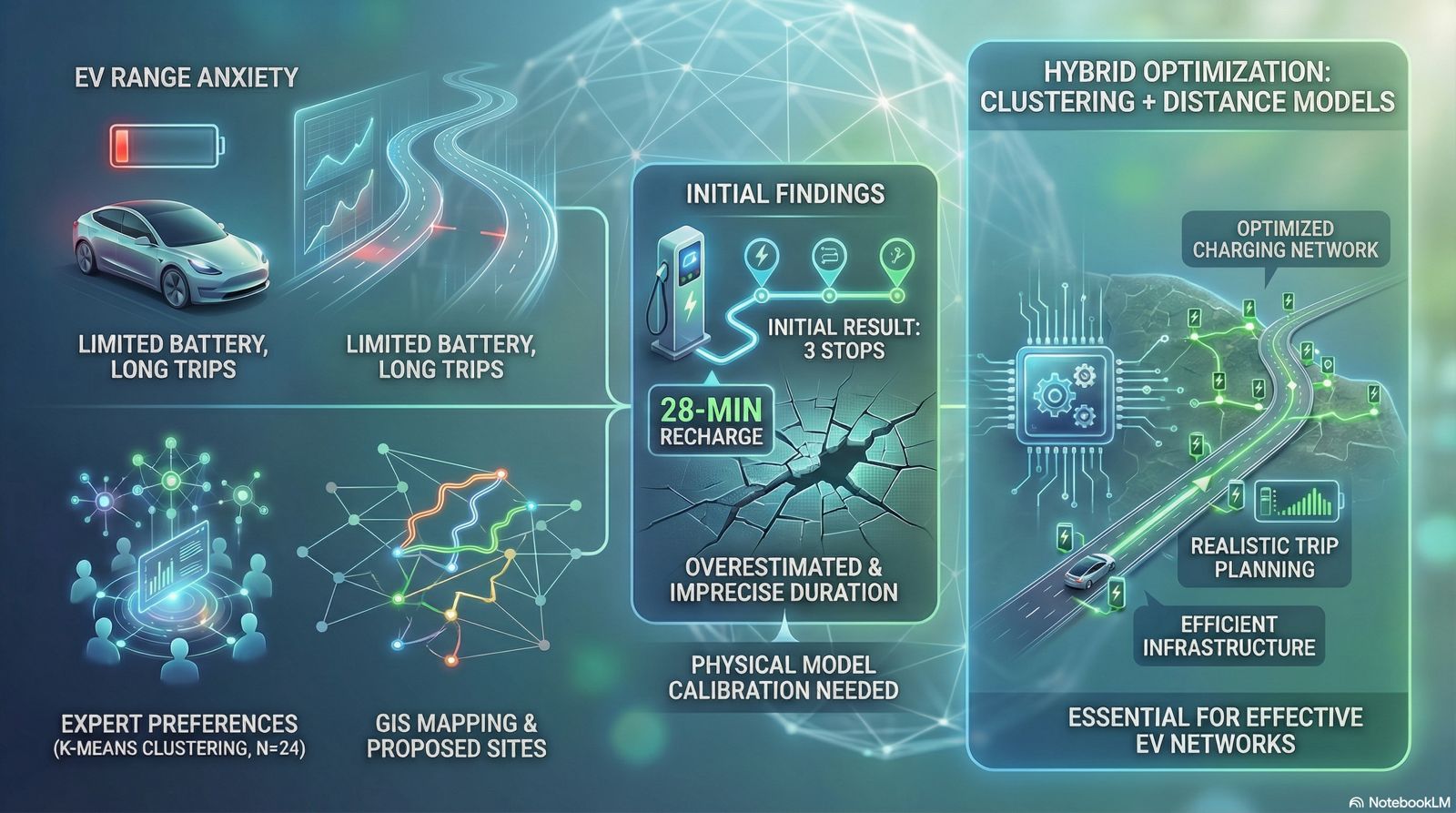
The increasing adoption of electric vehicles (EVs) worldwide is driven by environmental concerns and the depletion of fossil fuels. Yet, the limited battery range remains a significant barrier to their widespread use, particularly for long-distance travel. This study addresses this challenge by developing a methodology to determine the number of recharging stops, their durations, and strategic locations for electric vehicle charging stations (EVCSs) using k-means clustering analysis, with proposed station locations visualized within a GIS framework. The method integrates quantitative data from questionnaires administered to transportation experts and professionals (N=24) and applies it to case studies across three major highway routes in Ceará, Brazil. The k-means clustering proposed a solution of three stops with a 28-minute recharge time; however, subsequent analysis revealed this time was an overestimate compared to a more precise, distance-based linear model. A key implication is that while clustering can group user preferences, its direct output for operational parameters like charging time can be imprecise. Therefore, we demonstrate the necessity of calibrating such models with physically-grounded equations to achieve practical and efficient trip planning. This approach highlights the importance of integrating user preference data with distance-based models to create more realistic EV infrastructure plans for long-distance corridors.
Downloads
References
[2] A. Ghiasi, F. Zhou, and X. Li, “Speed Harmonization Algorithm using Connected Autonomous Vehicles,” presented at the 96th Annu. Meeting Transp. Res. Board, Washington, D.C., USA, 2017.
[3] International Energy Agency (IEA), Global EV Outlook 2025: Electric Vehicle Charging, 2025. [Online]. Available: https://www.iea.org/reports/global-ev-outlook-2025/electric-vehicle-charging
[4] Green Mountain Energy, "Key Electric Vehicle Technology Innovations for 2025 and Beyond," 2025. [Online]. Available: https://www.greennountainenergy.com/en/blog/electric-vehicle/electric-vehicle-technology-innovations-2025
[5] Y. Li et al., "Optimal Mileage of Electric Vehicles Considering Range Anxiety and Charging Times," World Electr. Veh. J., vol. 14, no. 1, 2023.
[6] B. D. Tasdemir, E. Koç, and A. İ. Simsek, “Capacited range coverage location model for electric vehicle charging stations: A case of Istanbul-Ankara highway,” Case Stud. Transp. Policy, vol. 19, 2025, Art. no. 101320.
[7] M. Kazempour, H. Sabboubeh, K. P. Moftakhari, R. Najafi, and G. Fusco, “GIS-based geospatial analysis for identifying optimal locations of residential on-street electric vehicle charging points in Birmingham, UK,” Sustain. Cities Soc., vol. 120, 2025, Art. no. 105988.
[8] L. Hanig, C. Ledna, D. Nock, C. D. Harper, A. Yip, E. Wood, and C. A. Spurlock, “Finding gaps in the national electric vehicle charging station coverage of the United States,” Nat. Commun., vol. 16, no. 1, 2025, Art. no. 561.
[9] Z. Sun et al., “Locating charging stations for electric vehicles,” Transp. Policy, vol. 98, pp. 48–54, 2020. [Online]. Available: https://doi.org/10.1016/j.tranpol.2018.07.009
[10] P. Jochem et al., “How many fast-charging stations do we need along European highways?” Transp. Res. Part D: Transp. Environ., vol. 73, pp. 120–129, 2019. [Online]. Available: https://doi.org/10.1016/j.trd.2019.06.005
[11] National Renewable Energy Laboratory (NREL), "EVI-RoadTrip: Electric Vehicle Infrastructure for Road Trips Tool," 2025. [Online]. Available: https://www.nrel.gov/transportation/evi-roadtrip
[12] A. Talebpour, "Optimizing Electric Vehicle Charging Station Locations: Exploring Grover's Quantum Search Algorithm," 2023. [Online]. Available: https://ccat.umtri.umich.edu/research/uiuc/optimizing-electric-vehicle-charging-station-locations-exploring-grovers-quantum-search-algorithm/
[13] H. B. Tambunan et al., "Initial Location Selection of Electric Vehicles Charging Infrastructure in Urban City Through Clustering Algorithm," Int. J. Electr. Comput. Eng., vol. 13, no. 3, pp. 3266–3280, 2023.
[14] A. K. Kalakanti and S. Rao, "Charging Station Planning for Electric Vehicles," Systems, vol. 10, no. 6, 2022.
[15] Z. Bendiabdellah et al., "A Hybrid Algorithm for Planning Public Charging Stations," in Proc. GIIS, Montreal, Canada, 2014, pp. 1–3.
[16] R. Richard, H. Cao, and M. Wachowicz, “Discovering EV recharging patterns through an automated analytical workflow,” in Proc. IEEE Int. Smart Cities Conf. (ISC2), Piscataway, NJ, USA, 2020, pp. 1–8.
[17] A. A. A. Al-Khafaji et al., "Optimizing Electric Vehicle Routing Efficiency Using k-Means Clustering and Genetic Algorithms," 2025. [Online]. Available: https://www.mdpi.com/3191270
[18] A. Shukla et al., “Consumer perspective-based placement of electric vehicle charging stations by clustering techniques,” in Proc. Nat. Power Syst. Conf. (NPSC), Bhubaneswar, India, 2016, pp. 1–6.
[19] F. Farhadi et al., “Data-driven multi-objective optimization for electric vehicle charging infrastructure,” iScience, vol. 26, 2023. [Online]. Available: https://doi.org/10.1016/j.isci.2023.107737
[20] B. Liu, W. Ni, and H. Zhu, “Optimal charging scheduling and speed control for delay-bounded drone delivery,” IEEE Trans. Veh. Technol., vol. 73, no. 11, pp. 16481–16490, 2024. [Online]. Available: https://doi.org/10.1109/TVT.2024.3405022
[21] J. Hassler et al., “Optimization and coordination of electric vehicle charging process for long-distance trips,” Energies, vol. 14, no. 13, p. 4054, 2021. [Online]. Available: https://doi.org/10.3390/en14134054
[22] H. Mosalli et al., "Dynamic Load Balancing for EV Charging Stations Using Reinforcement Learning and Demand Prediction," arXiv, 2025. [Online]. Available: https://arxiv.org/abs/2503.06370
[23] L. Fan et al., “A microgrid vehicle-to-grid energy scheduling optimization algorithm based on non-dominated sorting genetic algorithm II,” SAE Tech. Pap., 2025.
[24] R. Sriabisha et al., "A comprehensive exploration of electric vehicles: Classification, charging methods, obstacles, and approaches to optimization," 2025. [Online]. Available: https://www.researchgate.net/publication/380009491
[25] Driivz, “Top EV charging trends for 2025: Driivz predictions,” 2025. [Online]. Available: https://driivz.com/blog/top-ev-charging-trends-2025-predictions/
[26] M. S. Mastoi et al., “An in-depth analysis of electric vehicle charging station infrastructure, policy implications, and future trends,” Energy Rep., vol. 8, pp. 11504–11529, 2022. [Online]. Available: https://doi.org/10.1016/j.egyr.2022.09.011
[27] A. Joshi et al., "Likert scale: Explored and explained," Br. J. Appl. Sci. Technol., vol. 7, no. 4, pp. 396–403, 2015.
[28] S. T. Ahmed et al., “A generalized study on data mining and clustering algorithms: New trends in computational vision and bio-inspired computing,” in Proc. Int. Conf. Comput. Vis. Bio-Inspired Comput. (ICCVBIC), Coimbatore, India, 2020.
[29] J. Wang and X. Su, “An improved k-means clustering algorithm,” in Proc. IEEE Int. Conf. Commun. Softw. Netw., Xi’an, China, 2011, pp. 44–46.
Article Sidebar

Article Details

This work is licensed under a Creative Commons Attribution-NonCommercial-ShareAlike 4.0 International License.
Copyright Ownership
- Authors who publish their articles in Jurnal Optimasi Sistem Industri (JOSI) retain full copyright of their work.
- JOSI does not require authors to transfer their copyright to the journal or its publisher, Universitas Andalas. The authors grant JOSI a license for first publication.
All articles published in Jurnal Optimasi Sistem Industri (JOSI) are licensed under the Creative Commons Attribution-NonCommercial-ShareAlike 4.0 International (CC BY-NC-SA 4.0) license.
This means that users are free to:
- Share — copy and redistribute the material in any medium or format.
- Adapt — remix, transform, and build upon the material.
Under the following terms:
- Attribution (BY): You must give appropriate credit to the author(s) and JOSI as the original source of publication (including the article title, author(s) names, journal name, volume, issue, page numbers, year, and DOI), provide a link to the CC BY-NC-SA 4.0 license, and indicate if changes were made. You may do so in any reasonable manner, but not in any way that suggests the licensor endorses you or your use.
- NonCommercial (NC): You may not use the material for commercial purposes.
- ShareAlike (SA): If you remix, transform, or build upon the material, you must distribute your contributions under the same CC BY-NC-SA 4.0 license as the original.
A link to the full license text should also be provided: https://creativecommons.org/licenses/by-nc-sa/4.0/




Funding data
-
Conselho Nacional de Desenvolvimento Científico e Tecnológico
Grant numbers 407151/2021-4 -
Conselho Nacional de Desenvolvimento Científico e Tecnológico
Grant numbers 309755/2021-2