Mixed Methods Approach to Ergonomic Risk Assessment in Malaysian Railway Maintenance Operations
Main Article Content
Keywords
Physical ergonomics, Railway maintenance, 3D-CAD, virtual reality, Mixed methods
Abstract
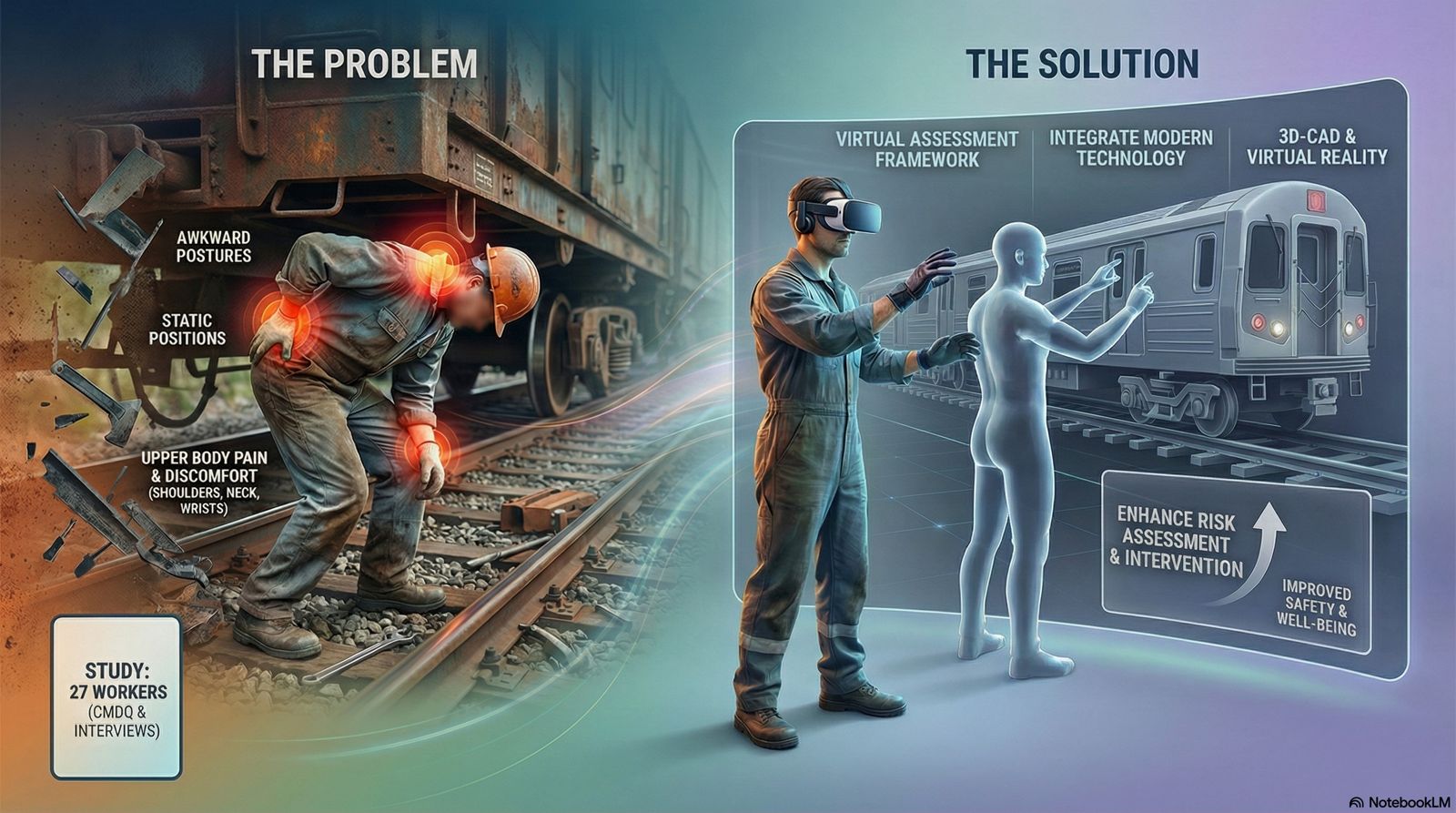
The safety and well-being of human personnel play an increasingly important role in determining whether prescribed objectives and overall performance goals are met in work environments. Various Ergonomic Risk Assessment (ERA) methodologies are thus constantly applied to examine whether risks and hazards that can lead to musculoskeletal disorders (MSDs) are present in these environments. This is especially true in high-risk industries, such as railway maintenance, where workers are subjected to repetitive tasks that are often dynamic and complex in nature. This study, therefore, proposes a conceptual framework to assess ergonomic risk factors (ERFs) in such environments, and suggests mechanisms for intervention. To achieve this, a Cornell Musculoskeletal Discomfort Questionnaire (CMDQ) was used to collect pain and discomfort data from 27 Malaysian railway maintenance workers (n=27). This was supported by semi-structured interviews, which provided context for the numerical results and incorporated workers’ perceptions of their routine tasks into the overall study design. Findings from the collected data showed that workers were often exposed to ERFs, including awkward and static postures over long periods of time. Pain and discomfort were also reported in upper body regions, including the shoulders, neck, and wrists. These results exposed the need for the incorporation of modern technological tools to support the assessment process. The proposed framework, therefore, sets a stage for the integration of Three-Dimensional Computer-Aided Design (3D-CAD) and Virtual Reality (VR) as simulation and visualization components of ERA.
Downloads
References
[2] A. Reiman, J. Kaivo-oja, E. Parviainen, E. P. Takala, and T. Lauraeus, “Human factors and ergonomics in manufacturing in the industry 4.0 context – A scoping review,” Technol Soc, vol. 65, no. December 2020, p. 101572, 2021, doi: 10.1016/j.techsoc.2021.101572.
[3] Y. Chen and Z. Wu, “A review on ergonomics evaluations of virtual reality,” Work, vol. 74, no. 3, pp. 831–841, 2023, doi: 10.3233/WOR-205232.
[4] H. Y. Akuma and N. H. Abdullah, “Innovative Ergonomic Solutions: Integrating 3D-CAD, Virtual Reality, and Mixed Methods for Railway Maintenance Workers,” Journal of Industrial Engineering and Halal Industries, vol. 6, no. 1, pp. 21–33, Jun. 2025, doi: 10.14421/jiehis.4978.
[5] R. Sebti, A. Boulila, and S. Hamza, “Ergonomics risk assessment among maintenance operators in a Tunisian railway company: A case study,” Hum Factors Ergon Manuf, vol. 30, no. 2, pp. 124–139, 2020, doi: 10.1002/hfm.20828.
[6] N. Ahzahar, R. Adawiyah Talib, S. Zubaidah Hashim, N. Mizal Azzmi, N. Jamaludin, and N. Mohd Noor, “Ergonomic Issues in Maintenance Work at Higher Learning Institutions,” International Journal of Business and Technology Management, vol. 5, no. S3, pp. 156–163, 2023, doi: 10.55057/ijbtm.2023.5.S3.16.
[7] T. M. Bisbey, R. Grossman, K. Panton, C. W. Coultas, and E. Salas, Design, Delivery, Evaluation, and Transfer of Effective Training Systems. 2021. doi: 10.1002/9781119636113.ch16.
[8] E. M. Capodaglio, “Participatory ergonomics for the reduction of musculoskeletal exposure of maintenance workers,” International Journal of Occupational Safety and Ergonomics, vol. 28, no. 1, pp. 376–386, 2022, doi: 10.1080/10803548.2020.1761670.
[9] N. Abdussalam and A. Ardiyanto, “Musculoskeletal symptom survey and ergonomic assessments associated with maintenance tasks in the Indonesian railway industry,” Int. J. Occup. Safety Health, vol. 14, no. 3, pp. 394–403, 2024, doi: 10.3126/ijosh.
[10] G. A. Garces, B. Rose, T. Blandet, I. Rasovska, and Q. Misslin, “Ergonom.io: A Virtual Reality tool for Ergonomic Assessment of Industrial Workplaces,” Proceedings of the 29th International Conference on Engineering, Technology, and Innovation: Shaping the Future, ICE 2023, 2023, doi: 10.1109/ICE/ITMC58018.2023.10332431.
[11] J. F. Cavalcanti, F. C. A. Duarte, R. C. F. Ayabe, and A. G. B. da Silva, “Virtual Reality and Ergonomics: Making the Immersive Experience,” Lecture Notes in Computer Science (including subseries Lecture Notes in Artificial Intelligence and Lecture Notes in Bioinformatics), vol. 12781 LNCS, no. September, pp. 158–170, 2021, doi: 10.1007/978-3-030-78227-6_12.
[12] N. S. Mujmule, S. D. Katekar, A. P. Gaikwad, S. C. Mali, and S. R. Koli, “A Systematic Ergonomics Approach of Maintenance Workstation,” IOP Conf Ser Mater Sci Eng, vol. 814, no. 1, 2020, doi: 10.1088/1757-899X/814/1/012032.
[13] M. Lorusso, M. Rossoni, and G. Colombo, “Conceptual modeling in product design within virtual reality environments,” Comput Aided Des Appl, vol. 18, no. 2, pp. 383–398, 2020, doi: 10.14733/cadaps.2021.383-398.
[14] S. S. Kumar and D. S. Ashok, “Integration of Virtual Reality and Digital Human Model Simulations for Ergonomic Analysis of CAD Models,” IOP Conf Ser Mater Sci Eng, vol. 1123, no. 1, p. 012056, Apr. 2021, doi: 10.1088/1757-899x/1123/1/012056.
[15] A. da Silva, M. Mendes, and I. Winkler, “Virtual Reality and Digital Human Modeling for the Physical Ergonomic Analysis in Product Development in Industry: A Systematic Review,” Nov. 22, 2021. doi: 10.20944/preprints202111.0402.v1.
[16] M. Rossoni, L. Bergonzi, and G. Colombo, “Integration of virtual reality in a knowledge-based engineering system for preliminary configuration and quotation of assembly lines,” Comput Aided Des Appl, vol. 16, no. 2, pp. 329–344, 2019, doi: 10.14733/cadaps.2019.329-344.
[17] M. M. Mahantesh et al., “Design and modeling using finite element analysis for the sitting posture of computer users based on ergonomic perspective,” International Journal on Interactive Design and Manufacturing, 2023, doi: 10.1007/s12008-023-01383-9.
[18] A. Corallo, M. Lazoi, G. Papadia, and C. Pascarelli, “Action Research on Virtual-Reality-Assisted Product and Process Design,” IEEE Trans Eng Manag, vol. 69, no. 6, pp. 3292–3309, 2022, doi: 10.1109/TEM.2020.3038461.
[19] C. Mauri and A. Antonovsky, “Using Mixed Methods to Strengthen Connections Between Human Factors and Complex Socio-technical Systems,” Lecture Notes in Networks and Systems, vol. 219 LNNS, pp. 737–746, 2021, doi: 10.1007/978-3-030-74602-5_100.
[20] H. Taherdoost, “What are Different Research Approaches? Comprehensive Review of Qualitative, Quantitative, and Mixed Method Research, Their Applications, Types, and Limitations,” Journal of Management Science & Engineering Research, vol. 5, no. 1, pp. 53–63, 2022, doi: 10.30564/jmser.v5i1.4538.
[21] D. Nagpal, I. Kornerup, and M. P. Gibson, “Mixed-method Research: A Basic Understanding,” CODS Journal of Dentistry, vol. 12, no. 1, pp. 11–16, Apr. 2021, doi: 10.5005/jp-journals-10063-0065.
[22] L. N. Kawar, G. B. Dunbar, E. M. Aquino-Maneja, S. L. Flores, V. Rondez Squier, and K. R. Failla, “Quantitative, Qualitative, Mixed Methods, and Triangulation Research Simplified,” J Contin Educ Nurs, vol. 55, no. 7, pp. 338–344, Jul. 2024, doi: 10.3928/00220124-20240328-03.
[23] A. Lowe, A. C. Norris, A. J. Farris, and D. R. Babbage, “Quantifying Thematic Saturation in Qualitative Data Analysis,” Field methods, vol. 30, no. 3, pp. 191–207, Aug. 2018, doi: 10.1177/1525822X17749386/SUPPL_FILE/LOWE.ETAL.SUPPLEMENT.REV(3).PDF.
[24] I. Yusoff, B. K. Ng, and S. A. Azizan, “Towards sustainable transport policy framework: A rail-based transit system in Klang Valley, Malaysia,” PLoS One, vol. 16, no. 3 March, Mar. 2021, doi: 10.1371/journal.pone.0248519.
[25] J. Golzar and O. Tajik, “Convenience Sampling,” 2022, doi: 10.22034/ijels.2022.162981.
[26] S. J. Stratton, “Population Research: Convenience Sampling Strategies,” Aug. 01, 2021, Cambridge University Press. doi: 10.1017/S1049023X21000649.
[27] “CUergo: Musculoskeletal Discomfort Questionnaires.” Accessed: Jun. 04, 2025. [Online]. Available: https://ergo.human.cornell.edu/ahmsquest.html
[28] H. W. Michon, H. Kroon, J. van Weeghel, and Aart. H. Schene, “The Generic Work Behavior Questionnaire (GWBQ): Assessment of Core Dimensions of Generic Work Behavior of People with Severe Mental Illnesses in Vocational Rehabilitation,” no. 28, 2004, doi: 10.2975/28.2004.40.47.
[29] A. K. Singh and R. J. Dalpatadu, “An Application of Bayesian Regression in Ergonomics,” Advances in Intelligent Systems and Computing, vol. 1217 AISC, pp. 367–373, 2020, doi: 10.1007/978-3-030-51828-8_47.
[30] J. G. Lugo-Armenta and L. R. Pino-Fan, “An approach to inferential reasoning levels on the Chi-square statistic,” Eurasia Journal of Mathematics, Science and Technology Education, vol. 20, no. 1, pp. 1–19, 2024, doi: 10.29333/EJMSTE/14119.
[31] S. Das, S. Patra, S. Danda, B. Mallick, and A. Pandey, “Working Posture Evaluation of Bus Drivers—Using CMDQ and RULA Technique,” in Lecture Notes in Networks and Systems, Springer Science and Business Media Deutschland GmbH, 2022, pp. 163–174. doi: 10.1007/978-3-030-94277-9_15.
[32] C. R. Lochmiller, “Conducting thematic analysis with qualitative data,” Qualitative Report, vol. 26, no. 6, pp. 2029–2044, Jun. 2021, doi: 10.46743/2160-3715/2021.5008.
[33] N. A. A. Hamid, N. A. Suhaimi, and M. H. Ismail, “The Impact of Safety Culture and Safety Behaviour Towards Safety Performance: A Case Study of KTMB ETS Railway Maintenance Staff,” Research in Management of Technology and Business, vol. 2, no. 2, pp. 281–296, 2021, [Online]. Available: http://publisher.uthm.edu.my/proceeding/index.php/rmtb
[34] I. Kačerová, J. Kubr, P. Hořejší, and J. Kleinová, “Ergonomic Design of a Workplace Using Virtual Reality and a Motion Capture Suit,” Applied Sciences (Switzerland), vol. 12, no. 4, Feb. 2022, doi: 10.3390/app12042150.
Article Sidebar

Article Details

This work is licensed under a Creative Commons Attribution-NonCommercial-ShareAlike 4.0 International License.
Copyright Ownership
- Authors who publish their articles in Jurnal Optimasi Sistem Industri (JOSI) retain full copyright of their work.
- JOSI does not require authors to transfer their copyright to the journal or its publisher, Universitas Andalas. The authors grant JOSI a license for first publication.
All articles published in Jurnal Optimasi Sistem Industri (JOSI) are licensed under the Creative Commons Attribution-NonCommercial-ShareAlike 4.0 International (CC BY-NC-SA 4.0) license.
This means that users are free to:
- Share — copy and redistribute the material in any medium or format.
- Adapt — remix, transform, and build upon the material.
Under the following terms:
- Attribution (BY): You must give appropriate credit to the author(s) and JOSI as the original source of publication (including the article title, author(s) names, journal name, volume, issue, page numbers, year, and DOI), provide a link to the CC BY-NC-SA 4.0 license, and indicate if changes were made. You may do so in any reasonable manner, but not in any way that suggests the licensor endorses you or your use.
- NonCommercial (NC): You may not use the material for commercial purposes.
- ShareAlike (SA): If you remix, transform, or build upon the material, you must distribute your contributions under the same CC BY-NC-SA 4.0 license as the original.
A link to the full license text should also be provided: https://creativecommons.org/licenses/by-nc-sa/4.0/
Hellstrome Young Akuma, Universiti Selangor
Hellstrome Young Akuma is a doctoral candidate at the Faculty of Engineering and Life Sciences, Universiti Selangor (UNISEL), Malaysia. He earned his Bachelor’s degree in Aeronautical Engineering from Shenyang Aerospace University, Liaoning, China, in 2016. In 2018, he pursued a Master’s degree in Engineering at UNISEL, where his research focused on the mathematical modelling and control systems of Ground Effect Vehicles. Currently, his doctoral research centres on optimizing ergonomic solutions for industrial applications by integrating advanced design tools and emerging technologies.
Nazlin Hanie Abdullah, Universiti Selangor
Nazlin Hanie Abdullah received a bachelor’s degree in Computer Aided Design and Manufacture from Universiti of Malaya, Kuala Lumpur, Malaysia. She pursued her Master’s Degree in Manufacturing Systems Engineering, Universiti Putra Malaysia, Selangor, Malaysia. Her Doctor of Philosophy is gained in PhD in Engineering Design, Universiti Malaya, Kuala Lumpur, Malaysia. Her current field placement is with Universiti Selangor in Mechanical Engineering Division, Faculty of Engineering & Life Sciences, Universiti Selangor, Malaysia for twenty two years. Her research area is ergonomics, human factor, and product design as well.