Acceptance and Satisfaction of Food Waste Mobile Application in a Developing Country: Insights from Extended UTAUT2 and IPMA
Main Article Content
Keywords
acceptance, satisfaction, FWMA, Indonesia, UTAUT, IPMA
Abstract
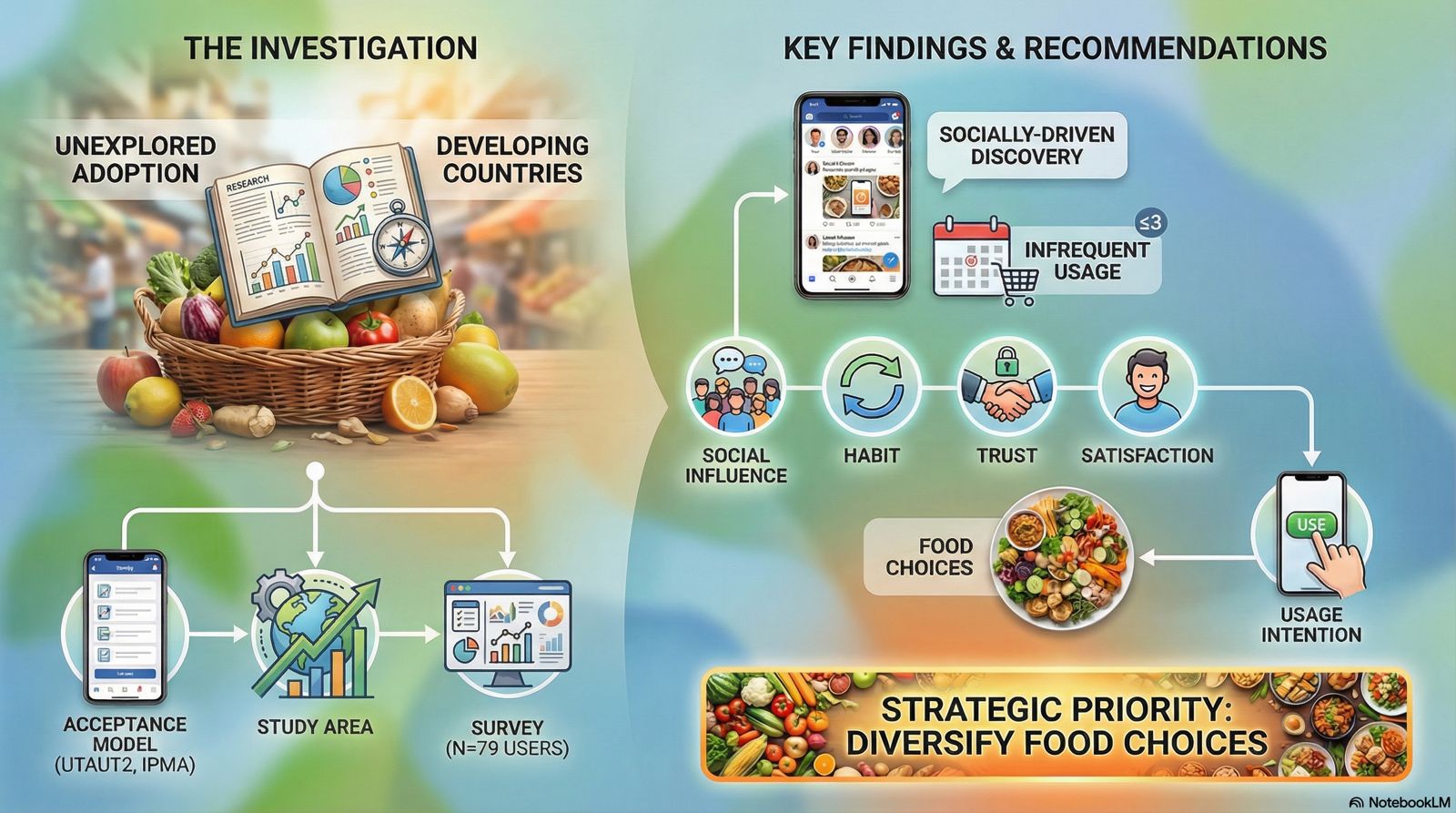
Food waste is a major global problem and has prompted the development of digital solutions such as food waste mobile applications (FWMA). However, factors influencing the user adoption of these applications, especially in developing countries, remain unexplored. The purpose of this study is to analyze existing behavior towards FWMA and modeling factors that influence acceptance of FWMA in the developing country - Indonesia, while also observing efforts to improve its effectiveness and user satisfaction. To achieve this, an acceptance model is developed using the Extended Unified Acceptance and Use Theory 2 (UTAUT2 Extended) model. Moreover, the Importance-Performance Matrix Analysis (IPMA) framework is used to identify areas for improvement and prioritize efforts to increase customer satisfaction in the application of the FWMA. A preliminary sample of 79 respondents completed an online questionnaire consisting of 30 questions and using a five-point Likert scale with anchor values of strongly agree and strongly disagree. The results show that the average frequency of purchases made by respondents via the FWMA system is relatively low, i.e., three or less per month, and that the majority of respondents learnt about the FWMA system from social media and their friends. As far as demographic data is concerned, women are more likely to use the FWMA than men. In particular, according to the UTAUT2 Extended Model, factors influencing satisfaction with the use of FWMA include social influence, habit and trust; furthermore, satisfaction and different food choices influence the intention to use the use of FWMA. Finally, the IPMA results reinforce the focus on increasing satisfaction through diversified food choices by providing a framework for developers and policy makers to support the uptake of the FWMA in developing economies by building trust, promoting habits and strategically increasing food diversity.
Downloads
References
[2] L. Ruetgers, “Selling surplus food as a solution to food waste understanding how businesses selling surplus food commercially can be adopted by consumers and reduce food waste”. Coventry University. Dissertation. 2002, Available at https://pureportal.coventry.ac.uk/en/studentTheses/selling-surplus-food-as-a-solution-to-food-waste.
[3] UNEP, “Food waste index report [WWW Document], 2021, Available at https://www.unep.or g/resources/report/unep-food-waste-index-report-2021, 10.28.21.
[4] FAO, “Global Food Losses and Food Waste” [online] Düsseldorf. 2021, Available at http://www.fao.org/docrep/014/mb060e/mb060e00.pdf.
[5] H. Jamaludin, H.S.E. Elmaky, and S. Sulaiman, “The future of food waste: Application of circular economy” Energy Nexus, vol. 7, p. 100098, 2022, doi: 10.1016/j.nexus.2022.100098.
[6] C.H. Huang, S. M. Liu, and N.Y. Hsu, “Understanding global food surplus and food waste to tackle economic and environmental sustainability” Sustainability, vol. 12, p. 2892. 2022, doi: 10.3390/su12072892.
[7] M.L. Spiker, H.A.B. Hiza, S.M. Siddiqi, and R.A. Neff, “Wasted food, wasted nutrients: Nutrient loss from wasted food in the United States and comparison to gaps in dietary intake”, Journal oaf Academic Nutrition Diet, vol. 117, pp. 1031–1040, 2017, doi: 10.1016/j.jand.2017.03.015
[8] J. Aschemann-Witzel, A. Giménez, and G. Ares, “Consumer in-store choice of suboptimal food to avoid food waste: The role of food category, communication and perception of quality dimensions”, Food Quality Preferences, vol.68, pp. 29–39, 2018, doi: 10.1016/j.foodqual.2018.01.020.
[9] S. Talwar, P. Kaur, R. Yadav, A., Bilgihan, and A., Dhir, “What drives diners’ eco-friendly behaviour? The moderating role of planning routine” Journal of Retail and Consumer Service vol. 63, p. 102678, 2021, doi: 10.1016/j.jretconser.2021.102678
[10] S. Baglioni, B. de Pieri, and T. Tallarico, “Surplus food recovery and food aid: the pivotal role of non-profit organisations: Insights from Italy and Germany”, Voluntas, vol. 28, pp. 2032–2052, 2017, doi: 10.1007/s11266-016-9746-8.
[11] A. Chalak, C., Abou-Daher, J. Chaaban, and M.G. Abiad, “The global economic and regulatory determinants of household food waste generation: A cross-country analysis” Waste Management, vol. 48, pp. 418–422, 2016, doi: 10.1016/j.wasman.2015.11.040.
[12] Z.X. Keng, S. Chong, C.G. Ng, N.I. Ridzuan, S. Hanson, G. Pan, P.L. Lau, C.V. Supramaniam, A. Singh, C.F. Chin, and H.L. Lam, “Community-scale composting for food waste: A life-cycle assessment-supported case study” Journal of Cleaner Production, vol. 261, p. 121220, 2020, doi: 10.1016/j.jclepro.2020.121220.
[13] J. Jin, S. Sun, D. Yang, W, Sheng, Y. Ma, W. He, and G. Li, “Anaerobic digestion: An alternative resource treatment option for food waste in China”. Science of Total Environment, vol. 779, 2021, doi: 10.1016/j.scitotenv.2021.146397.
[14] B. McCarthy, A.B Kapetanaki, and P. Wang, “Completing the food waste management loop: Is there market potential for value-added surplus products (VASP)?” Journal of Cleaner Production, vol. 256, p. 120435, 2020, doi: 10.1016/j.jclepro.2020.120435.
[15] C. Sundgreen, “Circular supply chain relationships for food redistribution Caroline Sundgren”, Journal of Cleaner Production, vol. 336, p. 130393, 2022, doi: 10.1016/j.jclepro.2022.130393
[16] S. Sanyal, S. Mukhopadhyay, and F. Xhafa, “Enhanced incentive schemes for volunteers to distribute surplus food in smart cities” Smart Cities, vol. 91, p. 104409, 2023, doi: 10.1016/j.scs.2023.104409.
[17] J. Harvey, A. Smith, J. Goulding, and I.B. Illodo, “Food sharing, redistribution, and waste reduction via mobile applications: A social network analysis”, Industrial Marketing Management , vol. 88, pp. 437-448, 2020, doi: 10.1016/j.indmarman.2019.02.019.
[18] J. Hong, N, Kafa, and A. Jaegler, “Exploring barriers and motivations in the adoption of food
waste mobile applications”, International Transaction in Operation Research, vol. 0, pp. 1–25, 2024,
DOI: 10.1111/itor.13587
[19] C. Apostolidis, D. Brown, D. Wijetunga, and E. Kathriarachchi, “Sustainable value co-creation at the Bottom of the Pyramid: using mobile applications to reduce food waste and improve food security” Journal of Marketing Management, vol. 37, pp. 856–886, 2021, doi: 10.1080/0267257X.2020.1863448
[20] A.A. Alalwan, “Mobile food ordering apps: An empirical study of the factors affecting customer e-satisfaction and continued intention to reuse”, International Journal of Information Management, vol. 50, pp. 28–44, 2020, doi: 10.1016/j.ijinfomgt.2019.04.008.
[21] S.L. Wong, C.C. Hsu, and H.S. Chen, “To buy or not to buy? Consumer attitudes and purchase intentions for suboptimal food” International Journal of Environmental Research and Public Health, vol. 15, p. 1431, 2018, doi: 10.3390/ijerph15071431.
[22] J. Chotigo, and Y. Kadono, “Comparative analysis of key factors encouraging food delivery app adoption before and during the covid-19 pandemic in Thailand”, Sustainability, vol. 13, No. 4088, pp. 1-25, 2021, doi: 10.3390/su13084088.
[23] S. Pandey, M. Budhathoki, K. Feng, M. Thomsen, and H.C. Reinbach, “Who buys surplus meals? An exploratory survey in Danish canteens” Foods, vol. 12, p. 1035, 2023, doi: 10.3390/foods12051035.
[24] Tracxn, “Tracking Market Activity,” Tracxn. [Online]. Available: https://w.tracxn.com/offerings/tracking-market-activity
[25] E. Keegan, and J.K. Breadsell, “Food waste and social practices in Australian households” Sustainability, vol. 13, no. 6, p. 3377, 2021, doi: 10.3390/su13063377.
[26] J. Kim, K. Knox, and S. Rundle-Thiele, Theory application in food waste behaviour programs: a systematic literature review, Australian Journal of Environmental Management, vol. 29, no. 4, pp. 344–367, 2022, doi: 10.1080/14486563.2022.2140211.
[27] G.B. Zamri, N.K.A. Azizal, S. Nakamura, K. Okada, N.H. Nordin, N.A. Othman, F.N.M.D. Akhir, A. Sobian, N. Kaida, and H. Hara, “Delivery, impact and approach of household food waste reduction campaigns,” Journal of Cleaner Production, vol. 246, p. 118969, 2020, doi: 10.1016/j.jclepro.2019.118969.
[28] V. Amicarelli, G. Lagioia, S. Sampietro, and C. Bux, “Has the COVID-19 pandemic changed food waste perception and behavior? Evidence from Italian consumers” Socio-Economic Planning Science, vol. 82, Part A, p. 101095, 2022, doi: 10.1016/j.seps.2021.101095.
[29] United Nations Environment Programme. Food Waste Index Report, 2021. Available at https://www.unep.org/resources/report/unep-food-waste-index-report-2021.
[30] Haryanti, N. Indonesia is the largest contributor of food waste in ASEAN. 2023. Available at https://infid.org/en/indonesia-penyumbang-sampah-makanan-terbanyak-se-asean/.
[31] F.D. Davis, “Perceived usefulness, perceived ease of use, and user acceptance of information technology” MIS Quarterly, vol. 13, no. 3, pp, 319-340, 1989,
[32] V. Venkatesh, M.G. Morris, G.B. Davis, and F.D. Davis, “User acceptance of information technology: Toward a unified view” MIS Quarterly, vol.27, no.3, pp. 425–478, 2023, doi: 10.2307/30036540.
[33] I. Ajzen, “The theory of planned behavior” Organizational Behavior and Human Decision Process, vol. 50, no. 2, pp. 179-211, 1991, doi: 10.1016/0749-5978(91)90020-T.
[34] S. Hauff, N.F. Richter, M. Sarstedt, and C.M. Ringle, “Importance and performance in PLS-SEM and NCA: Introducing the combined Importance-Performance Map Analysis (cIPMA)” Journal of Retailing and Consumer Service, vol., no. 78, p. 103723, 2024, doi: 10.1016/j.jretconser.2024.103723.
[35] S. Vercillo, “Food waste – What do women have to do with it? 2016, Available at https://foodwastestudies.com/2016/03/18/food-waste-what-do-women-have-to-do-with-it/.
[36] H., Chae, S. Kim, J. Lee, and K. Park, “Impact of product characteristics of limited edition shoes on perceived value, brand trust, and purchase intention; focused on the scarcity message frequency” Journal of Business Research, vol, 120, pp. 398–406, 2020,
[37] H.C. Wu, C.C. Cheng, and C.H. Ai, “A study of experiential quality, experiential value, trust, corporate reputation, experiential satisfaction, and behavioral intentions for cruise tourists: The case of Hong Kong” Tourism Management, vol. 66, pp. 200–220, 2018,
[38] J.D. Zhao, J. S. Huang, and S. Su, “The effects of trust on consumers’ continuous purchase intentions in C2C social commerce: A trust transfer perspective”, Journal of Retailing and Consumer Service, vol. 50, pp. 42–49, 2019.
[39] C. Jiang, R.M. Rashid, and J. Wang, “Investigating the role of social presence dimensions and information support on consumers’ trust and shopping intentions”, Journal of Retail and Consumer Service, vol. 51, pp. 263–270, 2019,
[40] A.K. Kar, “What affects usage satisfaction in mobile payments? Modelling user generated content to develop the “digital service usage satisfaction model”, Information System Frontier, vol, 23, pp. 1341–1361, 2021, doi: 10.1007/s10796-020-10045-0.
[41] F. Fernqvist, S. Spendrup, and R. Tellström, “Understanding food choice: A systematic review of reviews”, Heliyon, vol, 10, no, 12, p. e32492, 2024, doi: 10.1016/j.heliyon.2024.e32492.
[42] A. Widyanti, I. Sunaryo, and A.D. Kumalasari, “Reducing the dependency on rice as staple food in Indonesia - A behavior intervention approach”, Journal of the International Society for Southeast Asian Agricultural Sciences, vol. 20, no. 1, pp. 93–103, 2014.
[43] N. Ansori, A. Widyanti, and Yassierli, “The role of safety silence motives to safety communication and safety participation in different sectors of small and medium enterprises: Investigation results on two kinds of industries in indonesia”. Safety and Health at Work, vol. 12, No. 2, pp. 192–200, 2021, https://www.sciencedirect.com/science/article/pii/S2093791120303425
[44] N. Ansori, N., A. Widyanti, and Yassierli, “The influence of safety climate, motivation, and knowledge on worker compliance and participation: An empirical study of indonesian smes | La influencia del clima, la motivación y el conocimiento de seguridades en el cumplimiento y la participación de los trabajadores: Un estudio empírico de pymes en Indonesia”, Ingenieria e Investigacion, vo;, 41, no. 3, p. e83763, 2021, doi: 10.15446/ing.investig.v41n3.83763
Article Sidebar

Article Details

This work is licensed under a Creative Commons Attribution-NonCommercial-ShareAlike 4.0 International License.
Copyright Ownership
- Authors who publish their articles in Jurnal Optimasi Sistem Industri (JOSI) retain full copyright of their work.
- JOSI does not require authors to transfer their copyright to the journal or its publisher, Universitas Andalas. The authors grant JOSI a license for first publication.
All articles published in Jurnal Optimasi Sistem Industri (JOSI) are licensed under the Creative Commons Attribution-NonCommercial-ShareAlike 4.0 International (CC BY-NC-SA 4.0) license.
This means that users are free to:
- Share — copy and redistribute the material in any medium or format.
- Adapt — remix, transform, and build upon the material.
Under the following terms:
- Attribution (BY): You must give appropriate credit to the author(s) and JOSI as the original source of publication (including the article title, author(s) names, journal name, volume, issue, page numbers, year, and DOI), provide a link to the CC BY-NC-SA 4.0 license, and indicate if changes were made. You may do so in any reasonable manner, but not in any way that suggests the licensor endorses you or your use.
- NonCommercial (NC): You may not use the material for commercial purposes.
- ShareAlike (SA): If you remix, transform, or build upon the material, you must distribute your contributions under the same CC BY-NC-SA 4.0 license as the original.
A link to the full license text should also be provided: https://creativecommons.org/licenses/by-nc-sa/4.0/
Rifko Rahmat Kurnianto, Institut Teknologi Bandung; University of Groningen
Department of Human Movement Sciences, University of Groningen. Netherland
Faculty of Industrial Technology, Institut Teknologi Bandung, Indonesia