Cognitive Load Assessment in Multitasking: An fNIRS Study of Prefrontal Cortex Activation for Ergonomic Insight
Main Article Content
Keywords
multitasking, functional near-infrared spectroscopy, prefrontal cortex, cognitive load
Abstract
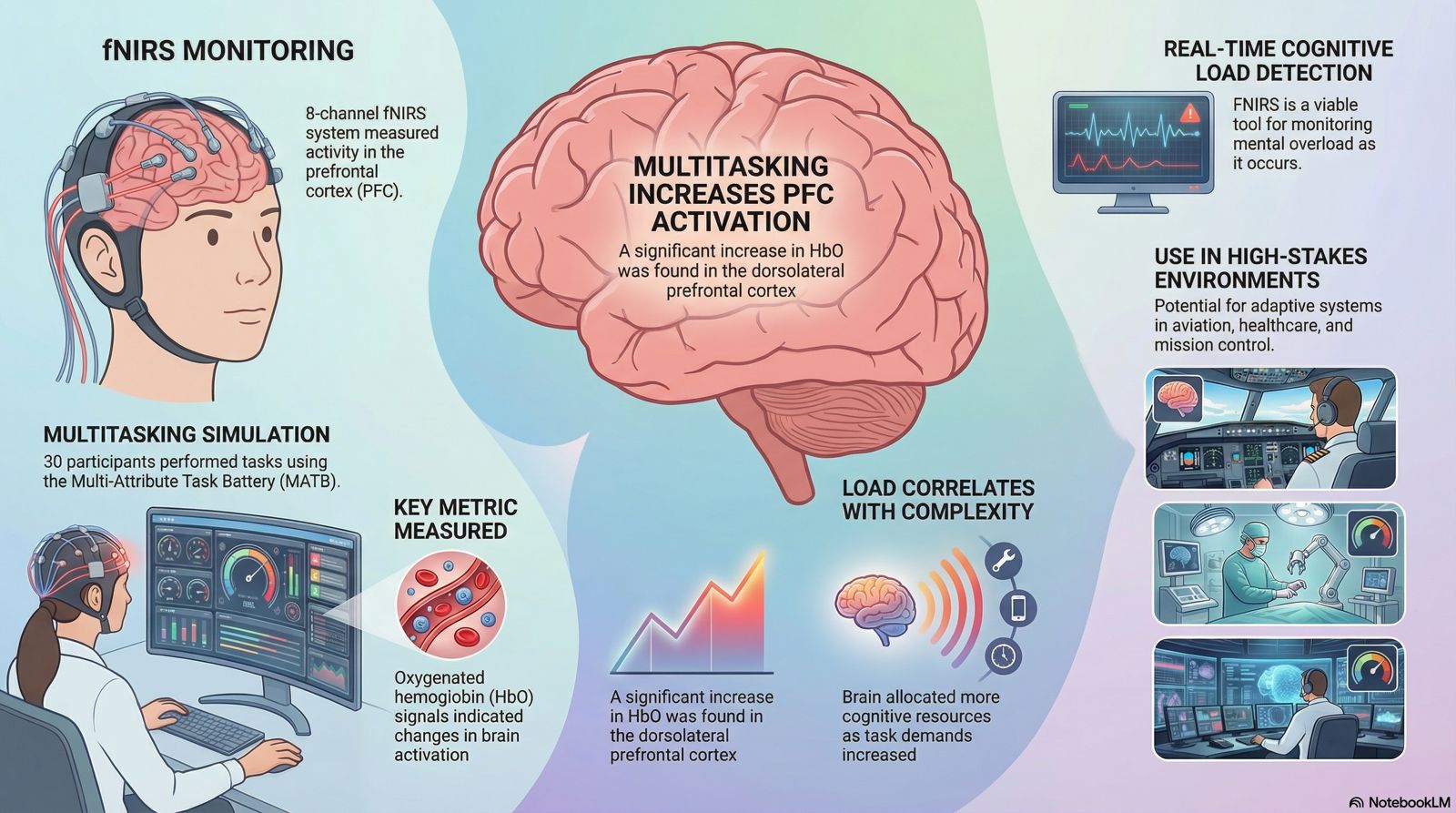
Although traditional neuroimaging techniques like fMRI and EEG have yielded insightful results, their rigid movement limitations restrict their practical use. Functional near-infrared spectroscopy (fNIRS) offers a practical alternative by allowing researchers to measure cortical activity during more natural task performance, particularly in the prefrontal cortex (PFC)—a key region for attention and executive control. This study uses fNIRS to investigate how multitasking demands affect PFC activation. An eight-channel fNIRS system recorded the brain activity of thirty participants as they completed tasks from the Multi-Attribute Task Battery (MATB). Oxygenated hemoglobin (HbO) signals were the main focus of data preprocessing, and AtlasViewer was used to visualize cortical projections. The superior and middle frontal gyri, which are linked to the dorsolateral prefrontal cortex (dlPFC), showed a significant increase in HbO responses when multitasking. On the other hand, lower activation levels were produced under less demanding circumstances. These results are consistent with resource-based models of attention, which postulate that the brain allocates more cognitive resources, especially in the right PFC, as task complexity increases. Beyond theoretical ramifications, this study shows that fNIRS can be used to detect cognitive load in real time. In high-stakes settings like aviation, healthcare, and mission-critical operations, this capability has potential uses in adaptive systems intended to monitor and reduce mental overload. This study emphasizes fNIRS as a useful tool for comprehending and managing multitasking in today's dynamic work contexts by bridging laboratory research and real-world settings.
Downloads
References
[2] Cristofori, S. Cohen-Zimerman, and J. Grafman, “Chapter 11 - Executive functions,” in Handbook of Clinical Neurology, vol. 163, M. D’Esposito and J. H. Grafman, Eds., Elsevier, 2019, pp. 197–219.
doi: 10.1016/B978-0-12-804281-6.00011-2.
[3] S. A. Himi, M. Bühner, M. Schwaighofer, A. Klapetek, and S. Hilbert, “Multitasking behavior and its related constructs: Executive functions, working memory capacity, relational integration, and divided attention,” Cognition, vol. 189, pp. 275–298, Aug. 2019. doi: 10.1016/j.cognition.2019.04.010.
[4] F. Buttelmann and J. Karbach, “Development and Plasticity of Cognitive Flexibility in Early and Middle Childhood,” Frontiers in Psychology, vol. 8, 2017. doi: 10.3389/fpsyg.2017.01040.
[5] R. Neill, “Multitasking, an EEG experiment: comparative analysis of cognitive workload during demanding stimuli presentation,” Neural Computing and Applications, vol. 37, no. 1, pp. 457–473, Jan. 2025. doi: 10.1007/s00521-024-10628-x.
[6] P. A. G. Asuako, R. Stojan, O. Bock, M. Mack, and C. Voelcker-Rehage, “Multitasking: does task-switching add to the effect of dual-tasking on everyday-like driving behavior?,” Cognitive Research: Principles and Implications, vol. 10, no. 1, p. 5, Feb. 2025. doi: 10.1186/s41235-025-00611-y.
[7] S. Marti, J.-R. King, and S. Dehaene, “Time-Resolved Decoding of Two Processing Chains during Dual-Task Interference,” Neuron, vol. 88, no. 6, pp. 1297–1307, Dec. 2015. doi: 10.1016/j.neuron.2015.10.040.
[8] C. M. Lewis, R. S. Gutzwiller, and C. K. Johnson, “Priority influences task selection decisions in multi-task management,” Applied Ergonomics, vol. 119, p. 104317, Sept. 2024. doi: 10.1016/j.apergo.2024.104317.
[9] N. Debue and C. van de Leemput, “What does germane load mean? An empirical contribution to the cognitive load theory,” Frontiers in Psychology, vol. 5, p. 1099, Oct. 2014. doi: 10.3389/fpsyg.2014.01099.
[10] J. A. Bueno-Vesga, X. Xu, and H. He, “The Effects of Cognitive Load on Engagement in a Virtual Reality Learning Environment,” in 2021 IEEE Virtual Reality and 3D User Interfaces (VR), Mar. 2021, pp. 645–652. doi: 10.1109/VR50410.2021.00090.
[11] J. Huang, Z. H. Pugh, S. Kim, and C. S. Nam, “Brain dynamics of mental workload in a multitasking context: Evidence from dynamic causal modeling,” Computers in Human Behavior, vol. 152, p. 108043, Mar. 2024. doi: 10.1016/j.chb.2023.108043.
[12] K. Boere, F. Anderson, K. G. Hecker, and O. E. Krigolson, “Measuring cognitive load in multitasking using mobile fNIRS,” NeuroImage: Reports, vol. 4, no. 4, p. 100228, Dec. 2024. doi: 10.1016/j.ynirp.2024.100228.
[13] J. Pina et al., “The Effect of Cognitive Load on Visual Search Tasks in Multisensory Immersive Environments,” in 2025 IEEE Conference on Virtual Reality and 3D User Interfaces Abstracts and Workshops (VRW), Mar. 2025, pp. 1444–1445. doi: 10.1109/VRW66409.2025.00368.
[14] D. A. Eldreth et al., “Evidence for multiple manipulation processes in prefrontal cortex,” Brain Research, vol. 1123, no. 1, pp. 145–156, Dec. 2006. doi: 10.1016/j.brainres.2006.07.129.
[15] M. Altamura et al., “Dissociating the effects of Sternberg working memory demands in prefrontal cortex,” Psychiatry Research, vol. 154, no. 2, pp. 103–114, Feb. 2007. doi: 10.1016/j.pscychresns.2006.08.002.
[16] K. Sakamoto, N. Saito, S. Yoshida, and H. Mushiake, “Dynamic Axis-Tuned Cells in the Monkey Lateral Prefrontal Cortex during a Path-Planning Task,” Journal of Neuroscience, vol. 40, no. 1, pp. 203–219, Jan. 2020. doi: 10.1523/JNEUROSCI.2526-18.2019.
[17] J. Tanji, K. Shima, and H. Mushiake, “Concept-based behavioral planning and the lateral prefrontal cortex,” Trends in Cognitive Sciences, vol. 11, no. 12, pp. 528–534, Dec. 2007. doi: 10.1016/j.tics.2007.09.007.
[18] L. Yang, M. Li, F. A. Wilson, X. Hu, and Y. Ma, “Prefrontal attention and multiple reference frames during working memory in primates,” Chinese Science Bulletin, vol. 58, no. 4, pp. 449–455, Feb. 2013.
doi: 10.1007/s11434-012-5462-y.
[19] J. Tanji and E. Hoshi, “Role of the lateral prefrontal cortex in executive behavioral control,” Physiological Reviews, vol. 88, no. 1, pp. 37–57, Jan. 2008. doi: 10.1152/physrev.00014.2007.
[20] O. Longe, C. Senior, and G. Rippon, “The lateral and ventromedial prefrontal cortex work as a dynamic integrated system: evidence from fMRI connectivity analysis,” Journal of Cognitive Neuroscience, vol. 21, no. 1, pp. 141–154, Jan. 2009. doi: 10.1162/jocn.2009.21012.
[21] M. Roy, D. Shohamy, and T. D. Wager, “Ventromedial prefrontal-subcortical systems and the generation of affective meaning,” Trends in Cognitive Sciences, vol. 16, no. 3, pp. 147–156, Mar. 2012.
doi: 10.1016/j.tics.2012.01.005.
[22] C. F. Geissler, G. Domes, and C. Frings, “Shedding light on the frontal hemodynamics of spatial working memory using functional near-infrared spectroscopy,” Neuropsychologia, vol. 146, p. 107570, Sept. 2020.
doi: 10.1016/j.neuropsychologia.2020.107570.
[23] N. F. Agbangla, M. Audiffren, J. Pylouster, and C. T. Albinet, “Load-Dependent Prefrontal Cortex Activation Assessed by Continuous-Wave Near-Infrared Spectroscopy during Two Executive Tasks with Three Cognitive Loads in Young Adults,” Brain Sciences, vol. 12, no. 11, p. 1462, Oct. 2022.
doi: 10.3390/brainsci12111462.
[24] M. K. Mian, S. A. Sheth, S. R. Patel, K. Spiliopoulos, E. N. Eskandar, and Z. M. Williams, “Encoding of rules by neurons in the human dorsolateral prefrontal cortex,” Cerebral Cortex, vol. 24, no. 3, pp. 807–816, Mar. 2014. doi: 10.1093/cercor/bhs361.
[25] J. Jung, M. A. L. Ralph, and R. L. Jackson, “Subregions of DLPFC Display Graded yet Distinct Structural and Functional Connectivity,” Journal of Neuroscience, vol. 42, no. 15, pp. 3241–3252, Apr. 2022.
doi: 10.1523/JNEUROSCI.1216-21.2022.
[26] [26] M. Zhang, U. Nathaniel, N. Savill, J. Smallwood, and E. Jefferies, “Intrinsic connectivity of left ventrolateral prefrontal cortex predicts individual differences in controlled semantic retrieval,” NeuroImage, vol. 246, p. 118760, Feb. 2022. doi: 10.1016/j.neuroimage.2021.118760.
[27] N. Nozari and S. L. Thompson-Schill, “Chapter 46 - Left Ventrolateral Prefrontal Cortex in Processing of Words and Sentences,” in Neurobiology of Language, G. Hickok and S. L. Small, Eds., Academic Press, 2016, pp. 569–584. doi: 10.1016/B978-0-12-407794-2.00046-8.
[28] T. R. H. Cutmore and D. A. James, “Sensors and sensor systems for psychophysiological monitoring: A review of current trends,” Journal of Psychophysiology, vol. 21, no. 1, pp. 51–71, 2007. doi: 10.1027/0269-8803.21.1.51.
[29] Biasiucci, B. Franceschiello, and M. M. Murray, “Electroencephalography,” Current Biology, vol. 29, no. 3, pp. R80–R85, Feb. 2019. doi: 10.1016/j.cub.2018.11.052.
[30] Kesedžić, M. Šarlija, J. Božek, S. Popović, and K. Ćosić, “Classification of Cognitive Load Based on Neurophysiological Features From Functional Near-Infrared Spectroscopy and Electrocardiography Signals on n-Back Task,” IEEE Sensors Journal, vol. 21, no. 13, pp. 14131–14140, July 2021. doi: 10.1109/JSEN.2020.3038032.
[31] J. Pereira, B. Direito, M. Lührs, M. Castelo-Branco, and T. Sousa, “Multimodal assessment of the spatial correspondence between fNIRS and fMRI hemodynamic responses in motor tasks,” Scientific Reports, vol. 13, no. 1, p. 2244, Feb. 2023. doi: 10.1038/s41598-023-29123-9.
[32] S. Sanchez-Alonso, R. R. Canale, I. F. Nichoson, and R. N. Aslin, “Simultaneous Data Collection of fMRI and fNIRS Measurements Using a Whole-Head Optode Array and Short-Distance Channels,” J Vis Exp, no. 200, Oct. 2023. doi: 10.3791/65088.
[33] S. Bollmann and M. Barth, “New acquisition techniques and their prospects for the achievable resolution of fMRI,” Prog Neurobiol, vol. 207, p. 101936, Dec. 2021. doi: 10.1016/j.pneurobio.2020.101936.
[34] Y. Tang, D. Chen, H. Liu, C. Cai, and X. Li, “Deep EEG Superresolution via Correlating Brain Structural and Functional Connectivities,” IEEE Trans Cybern, vol. 53, no. 7, pp. 4410–4422, Jul. 2023.
doi: 10.1109/TCYB.2022.3178370.
[35] S.-P. Muthukrishnan, N. Ahuja, N. Mehta, and R. Sharma, “Functional brain microstate predicts the outcome in a visuospatial working memory task,” Behav Brain Res, vol. 314, pp. 134–142, Nov. 2016.
doi: 10.1016/j.bbr.2016.08.020.
[36] C. Luu et al., “Correlating Motion Artifacts in Wet and Dry Electrodes With Head Kinematics During Physical Activities in Ambulatory EEG Monitoring,” IEEE Trans Instrum Meas, vol. 73, pp. 1–10, 2024.
doi: 10.1109/TIM.2024.3398124.
[37] M. Â. M. Devezas, “Shedding light on neuroscience: Two decades of functional near-infrared spectroscopy applications and advances from a bibliometric perspective,” J Neuroimaging, vol. 31, no. 4, pp. 641–655, 2021. doi: 10.1111/jon.12877.
[38] H. Santosa, “Optical Imaging Technique: A Powerful Tool for Neuroscience,” in 2021 International Conference on Instrumentation, Control, and Automation (ICA), Aug. 2021, pp. 16–16. doi: 10.1109/ICA52848.2021.9625668.
[39] M. Causse, Z. Chua, V. Peysakhovich, N. D. Campo, and N. Matton, “Mental workload and neural efficiency quantified in the prefrontal cortex using fNIRS,” Sci Rep, vol. 7, no. 1, p. 5222, Jul. 2017.
doi: 10.1038/s41598-017-05378-x.
[40] Zinos et al., “Spatial correspondence of cortical activity measured with whole head fNIRS and fMRI: Toward clinical use within subject,” Neuroimage, vol. 290, p. 120569, Apr. 2024. doi: 10.1016/j.neuroimage.2024.120569.
[41] L. Duan, Y.-J. Zhang, and C.-Z. Zhu, “Quantitative comparison of resting-state functional connectivity derived from fNIRS and fMRI: A simultaneous recording study,” Neuroimage, vol. 60, no. 4, pp. 2008–2018, May 2012. doi: 10.1016/j.neuroimage.2012.02.014.
[42] F. Klein, S. H. Kohl, M. Lührs, D. M. A. Mehler, and B. Sorger, “From lab to life: challenges and perspectives of fNIRS for haemodynamic-based neurofeedback in real-world environments,” Philos Trans R Soc B, Dec. 2024. doi: 10.1098/rstb.2023.0087.
[43] R. Sitaram et al., “Closed-loop brain training: the science of neurofeedback,” Nat Rev Neurosci, vol. 18, no. 2, pp. 86–100, Feb. 2017. doi: 10.1038/nrn.2016.164.
[44] S. H. Kohl et al., “Corrigendum: The Potential of Functional Near-Infrared Spectroscopy-Based Neurofeedback—A Systematic Review and Recommendations for Best Practice,” Front Neurosci, vol. 16, Aug. 2022. doi:10.3389/fnins.2022.907941
[45] D. Mac-Auliffe et al., “The Dual-Task Cost Is Due to Neural Interferences Disrupting the Optimal Spatio-Temporal Dynamics of the Competing Tasks,” Front Behav Neurosci, vol. 15, p. 640178, 2021. doi: 10.3389/fnbeh.2021.640178.
[46] M. M. Swerdloff and L. J. Hargrove, “Dry EEG measurement of P3 to evaluate cognitive load during sitting, standing, and walking,” PLOS ONE, vol. 18, no. 7, p. e0287885, Jul. 2023. doi: 10.1371/journal.pone.0287885.
[47] F. Faul, E. Erdfelder, A.-G. Lang, and A. Buchner, “G*Power 3: A flexible statistical power analysis program for the social, behavioral, and biomedical sciences,” Behav Res Methods, vol. 39, no. 2, pp. 175–191, 2007. doi: 10.3758/BF03193146.
[48] G. Vergotte, S. Perrey, M. Muthuraman, S. Janaqi, and K. Torre, “Concurrent Changes of Brain Functional Connectivity and Motor Variability When Adapting to Task Constraints,” Front Physiol, vol. 9, Jul. 2018. doi: 10.3389/fphys.2018.00909.
[49] L. Rosso et al., “Prefrontal cortex activation while walking did not change but gait speed improved after a randomized physical therapy intervention,” Aging Clin Exp Res, vol. 36, no. 1, p. 43, Feb. 2024. doi: 10.1007/s40520-023-02666-7.
[50] J. R. Comstock and R. J. Arnegard, The Multi-Attribute Task Battery for Human Operator Workload and Strategic Behavior Research, NASA Langley Research Center, Hampton, VA, NASA-TM-104174, 1992.
[51] J. Ferraro, N. Christy, and M. Mouloua, “Impact of Auditory Interference on Automated Task Monitoring and Workload,” Proc Hum Factors Ergon Soc Annu Meet, vol. 61, no. 1, pp. 1136–1140, Sep. 2017. doi: 10.1177/1541931213601768.
[52] J. H. Kim and X. Yang, “Applying fractal analysis to pupil dilation for measuring complexity in a process monitoring task,” Appl Ergon, vol. 65, pp. 61–69, Nov. 2017. doi: 10.1016/j.apergo.2017.06.002.
[53] F. Herold, P. Wiegel, F. Scholkmann, and N. G. Müller, “Applications of Functional Near-Infrared Spectroscopy (fNIRS) Neuroimaging in Exercise–Cognition Science: A Systematic, Methodology-Focused Review,” J Clin Med, vol. 7, no. 12, Nov. 2018. doi: 10.3390/jcm7120466.
[54] T. J. Huppert, S. G. Diamond, M. A. Franceschini, and D. A. Boas, “HomER: a review of time-series analysis methods for near-infrared spectroscopy of the brain,” Appl Opt, vol. 48, no. 10, pp. 280–298, Apr. 2009.
[55] Y. Zhang, D. H. Brooks, M. A. Franceschini, and D. A. Boas, “Eigenvector-based spatial filtering for reduction of physiological interference in diffuse optical imaging,” J Biomed Opt, vol. 10, no. 1, p. 011014, Jan. 2005. doi: 10.1117/1.1852552.
[56] R Core Team, R: A Language and Environment for Statistical Computing, Vienna, Austria, 2021.
[57] Mirelman et al., “Increased frontal brain activation during walking while dual tasking: an fNIRS study in healthy young adults,” J Neuroeng Rehabil, vol. 11, no. 1, p. 85, May 2014. doi: 10.1186/1743-0003-11-85.
[58] H. Sato et al., “Intersubject variability of near-infrared spectroscopy signals during sensorimotor cortex activation,” J Biomed Opt, vol. 10, no. 4, p. 044001, Jul. 2005. doi: 10.1117/1.1960907.
[59] N. Benikos, S. J. Johnstone, and S. J. Roodenrys, “Short-term training in the Go/Nogo task: behavioural and neural changes depend on task demands,” Int J Psychophysiol, vol. 87, no. 3, pp. 301–312, Mar. 2013. doi: 10.1016/j.ijpsycho.2012.12.001.
[60] S. S. Simon, E. S. Tusch, P. J. Holcomb, and K. R. Daffner, “Increasing Working Memory Load Reduces Processing of Cross-Modal Task-Irrelevant Stimuli Even after Controlling for Task Difficulty and Executive Capacity,” Front Hum Neurosci, vol. 10, p. 380, 2016. doi: 10.3389/fnhum.2016.00380.
[61] T. K. Lam, O. Vartanian, and J. G. Hollands, “The brain under cognitive workload: Neural networks underlying multitasking performance in the multi-attribute task battery,” Neuropsychologia, vol. 174, p. 108350, Sep. 2022. doi: 10.1016/j.neuropsychologia.2022.108350.
[62] Z. Cai, G. Pellegrino, J.-M. Lina, H. Benali, and C. Grova, “Hierarchical Bayesian modeling of the relationship between task-related hemodynamic responses and cortical excitability,” Hum Brain Mapp, vol. 44, no. 3, pp. 876–900, Feb. 2023. doi: 10.1002/hbm.26107.
[63] K. Lapanan, P. Kantha, G. Nantachai, S. Hemrungrojn, and M. Maes, “The prefrontal cortex hemodynamic responses to dual-task paradigms in older adults: A systematic review and meta-analysis,” Heliyon, vol. 9, no. 7, p. e17812, Jul. 2023. doi: 10.1016/j.heliyon.2023.e17812.
[64] S. A. Fraser, O. Dupuy, P. Pouliot, F. Lesage, and L. Bherer, “Comparable Cerebral Oxygenation Patterns in Younger and Older Adults during Dual-Task Walking with Increasing Load,” Front Aging Neurosci, vol. 8, p. 240, Oct. 2016. doi: 10.3389/fnagi.2016.00240.
[65] D. Vadas, L. Kalichman, A. Hadanny, and S. Efrati, “Hyperbaric Oxygen Environment Can Enhance Brain Activity and Multitasking Performance,” Front Integr Neurosci, vol. 11, p. 25, Sep. 2017. doi: 10.3389/fnint.2017.00025.
[66] B. Scholey, S. Benson, S. Sela-Venter, M. Mackus, and M. C. Moss, “Oxygen Administration and Acute Human Cognitive Enhancement: Higher Cognitive Demand Leads to a More Rapid Decay of Transient Hyperoxia,” J Cogn Enhanc, vol. 4, no. 1, pp. 94–99, Mar. 2020. doi: 10.1007/s41465-019-00145-4.
[67] M. Mahjoob et al., “Characterizing the Visual Cortex Function in Cognitive Task-Induced Mental Load: A Functional Magnetic Resonance Imaging Study,” Brain Connect, vol. 14, no. 3, pp. 189–197, Apr. 2024. doi: 10.1089/brain.2023.0049.
[68] C. M. Aasted et al., “Anatomical guidance for functional near-infrared spectroscopy: AtlasViewer tutorial,” Neurophotonics, vol. 2, no. 2, p. 020801, May 2015. doi: 10.1117/1.NPh.2.2.020801.
[69] M. Roca et al., “The role of Area 10 (BA10) in human multitasking and in social cognition: A lesion study,” Neuropsychologia, vol. 49, no. 13, pp. 3525–3531, Nov. 2011. doi: 10.1016/j.neuropsychologia.2011.09.003.
[70] W.-Y. Hsu, T. P. Zanto, J. A. Anguera, Y.-Y. Lin, and A. Gazzaley, “Delayed enhancement of multitasking performance: Effects of anodal transcranial direct current stimulation on the prefrontal cortex,” Cortex, vol. 69, pp. 175–185, Aug. 2015. doi: 10.1016/j.cortex.2015.05.014.
[71] T. Strobach, D. Antonenko, M. Abbarin, M. Escher, A. Flöel, and T. Schubert, “Modulation of dual-task control with right prefrontal transcranial direct current stimulation (tDCS),” Exp Brain Res, vol. 236, no. 1, pp. 227–241, Jan. 2018. doi: 10.1007/s00221-017-5121-2.
[72] S. Berry, M. Sarter, and C. Lustig, “Distinct frontoparietal networks underlying attentional effort and cognitive control,” J Cogn Neurosci, vol. 29, no. 7, pp. 1212–1225, Jul. 2017. doi: 10.1162/jocn_a_01112.
[73] E. Demeter, L. Hernandez-Garcia, M. Sarter, and C. Lustig, “Challenges to attention: a continuous arterial spin labeling (ASL) study of the effects of distraction on sustained attention,” Neuroimage, vol. 54, no. 2, pp. 1518–1529, Jan. 2011. doi: 10.1016/j.neuroimage.2010.09.026.
[74] B. Worringer, R. Langner, I. Koch, S. B. Eickhoff, C. R. Eickhoff, and F. C. Binkofski, “Common and distinct neural correlates of dual-tasking and task-switching: a meta-analytic review and a neuro-cognitive processing model of human multitasking,” Brain Struct Funct, vol. 224, no. 5, pp. 1845–1869, Jun. 2019. doi: 10.1007/s00429-019-01870-4.
[75] R. K. Spooner, J. A. Eastman, M. T. Rezich, and T. W. Wilson, “High-definition transcranial direct current stimulation dissociates fronto-visual theta lateralization during visual selective attention,” J Physiol, vol. 598, no. 5, pp. 987–998, Mar. 2020. doi: 10.1113/JP278788.
[76] C. Wickens, “Attention: Theory, Principles, Models and Applications,” Int J Hum–Comput Interact, vol. 37, no. 5, pp. 403–417, Mar. 2021. doi: 10.1080/10447318.2021.1874741.
[77] N. M. V. Morrison, D. Burnham, and B. W. Morrison, “Cognitive Load in Cross-Modal Dual-Task Processing,” Appl Cogn Psychol, vol. 29, no. 3, pp. 436–444, 2015. doi: 10.1002/acp.3122.
[78] H. A. Maior, M. Pike, S. Sharples, and M. L. Wilson, “Examining the Reliability of Using fNIRS in Realistic HCI Settings for Spatial and Verbal Tasks,” in Proc. CHI ’15, Seoul, Republic of Korea, 2015, pp. 3039–3042. doi: 10.1145/2702123.2702315.
[79] H. A. Maior, M. L. Wilson, and S. Sharples, “Workload Alerts—Using Physiological Measures of Mental Workload to Provide Feedback During Tasks,” ACM Trans Comput–Hum Interact, vol. 25, no. 2, Art. no. 9, Apr. 2018. doi: 10.1145/3173380.
[80] Tachtsidis and F. Scholkmann, “False positives and false negatives in functional near-infrared spectroscopy: issues, challenges, and the way forward,” Neurophotonics, vol. 3, no. 3, Jul. 2016. doi: 10.1117/1.NPh.3.3.031405.
[81] R. J. Cooper et al., “A Systematic Comparison of Motion Artifact Correction Techniques for Functional Near-Infrared Spectroscopy,” Front Neurosci, vol. 6, Art. 147, Oct. 2012. doi: 10.3389/fnins.2012.00147.
Article Sidebar

Article Details

This work is licensed under a Creative Commons Attribution-NonCommercial-ShareAlike 4.0 International License.
Copyright Ownership
- Authors who publish their articles in Jurnal Optimasi Sistem Industri (JOSI) retain full copyright of their work.
- JOSI does not require authors to transfer their copyright to the journal or its publisher, Universitas Andalas. The authors grant JOSI a license for first publication.
All articles published in Jurnal Optimasi Sistem Industri (JOSI) are licensed under the Creative Commons Attribution-NonCommercial-ShareAlike 4.0 International (CC BY-NC-SA 4.0) license.
This means that users are free to:
- Share — copy and redistribute the material in any medium or format.
- Adapt — remix, transform, and build upon the material.
Under the following terms:
- Attribution (BY): You must give appropriate credit to the author(s) and JOSI as the original source of publication (including the article title, author(s) names, journal name, volume, issue, page numbers, year, and DOI), provide a link to the CC BY-NC-SA 4.0 license, and indicate if changes were made. You may do so in any reasonable manner, but not in any way that suggests the licensor endorses you or your use.
- NonCommercial (NC): You may not use the material for commercial purposes.
- ShareAlike (SA): If you remix, transform, or build upon the material, you must distribute your contributions under the same CC BY-NC-SA 4.0 license as the original.
A link to the full license text should also be provided: https://creativecommons.org/licenses/by-nc-sa/4.0/
Rais Reskiawan A. Kadir, Bucks Institute for Research on Aging; Universitas Hasanuddin
Bucks Institute for Research on Aging