Digitalization and Sustainability Indicators for SMI Resilience in Developing Economies: A Conceptual Model from Padang City of Indonesia
Main Article Content
Keywords
digitalization, sustainability, resiliance, small and medium industries, indicator validation
Abstract
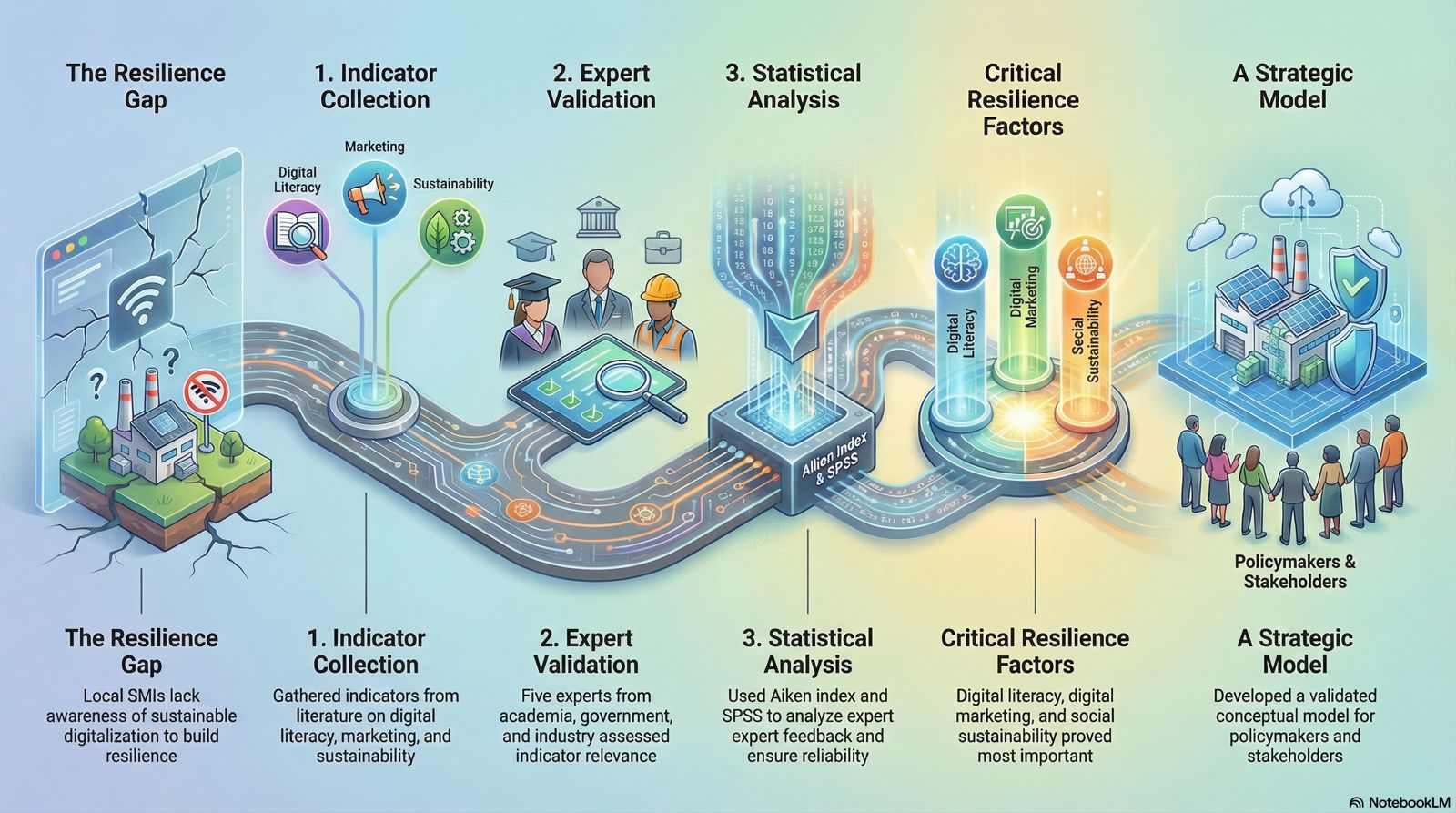
The application of digital technology increases productivity, expands market reach, helps small and medium industries (SMIs) adapt to various changes, and provides a great contribution to sustainability. Sustainability emphasizes the importance of maintaining economic, environmental, and social balance in the long term, while resilience describes the ability of SMIs to confront and recover from various disruptions. However, the SMIs in Padang are less aware of the importance of implementing digitalization sustainably to achieve SMI resilience. Several indicators remain unmet by SMIs. This study aims to compile and validate digitalization and sustainability indicators appropriate to the context of local SMIs. These indicators were collected from various literature sources that include digital literacy, digital marketing, economic, environmental, and social sustainability, and resilience aspects. The validation process involved five experts from academia, government, and industry practitioners selected based on their expertise in the fields of the aforementioned aspects. Experts assessed the relevance and clarity of each indicator using the Likert scale, then the results were analyzed with the Aiken index and tested for reliability between assessors using SPSS to ensure consistency of assessments. The results of the study show that these indicators are aligned with the dimensions measured, particularly those that affirm the importance of digital literacy, digital marketing, and social aspects of sustainability in strengthening the resilience of SMIs. These validated indicators were then used to develop a conceptual model that can be a strategic reference for stakeholders and policymakers to increase the competitiveness, resilience, and sustainability of SMIs in Padang.
Downloads
References
[2] M. Abou-Foul, J. L. Ruiz-Alba, and A. Soares, “The impact of digitalization and servitization on the financial performance of a firm: An empirical analysis,” Prod. Plan. Control, vol. 32, no. 12, pp. 975–989, 2021, doi: 10.1080/09537287.2020.1780508.
[3] A. da Silva and A. M. Cardoso, “Carbon footprint reduction in manufacturing SMEs through digital technologies,” Earth Planet. Insights, vol. 1, no. 1, pp. 23–36, Jul. 2024, doi: 10.35603/epi24.1.03.
[4] X. Chen, M. Despeisse, and B. Johansson, “Environmental sustainability of digitalization in manufacturing: A review,” Sustainability, vol. 12, no. 24, p. 10298, Dec. 2020, doi: 10.3390/su122410298.
[5] F. Tomaschko, L. Reichelt, and S. Krommes, “Digitalisation of manufacturing systems: A literature review of approaches to assess the sustainability of digitalisation technologies in production systems,” Sustainability, vol. 16, no. 15, p. 6275, Aug. 2024, doi: 10.3390/su16156275.
[6] S. Purnomo, Nurmalitasari, and Nurchim, “Digital transformation of MSMEs in Indonesia: A systematic literature review,” J. Manag. Digit. Bus., vol. 4, no. 2, pp. 301–312, 2024, doi: 10.53088/jmdb.v4i2.1121.
[7] G. Gayatri, I. G. N. M. Jaya, and V. M. Rumata, “The Indonesian digital workforce gaps in 2021–2025,” Sustainability, vol. 15, no. 1, p. 754, Jan. 2023, doi: 10.3390/su15010754.
[8] Badan Pusat Statistik, Kota Padang dalam Angka 2022. Jakarta, Indonesia: BPS, 2022.
[9] Peraturan Menteri Perindustrian Republik Indonesia Nomor 64/M-IND/PER/7/2016 tentang Peta Panduan Pengembangan Kompetensi Inti Industri Nasional, Indonesia, 2016.
[10] M. Kotarba, “Measuring digitalization—Key metrics,” Found. Manag., vol. 9, no. 1, pp. 123–138, Feb. 2017, doi: 10.1515/fman-2017-0010.
[11] S. R. Pratamansyah, “Transformasi digital dan pertumbuhan UMKM: Analisis dampak teknologi pada kinerja usaha kecil dan menengah di Indonesia,” J. Akunt. Manaj. Perenc. Kebijak., vol. 2, no. 2, pp. 1–17, 2024, doi: 10.47134/jampk.v2i2.475.
[12] Pusat Sumber Daya Perdesaan, Kearifan Lokal, dan Pembangunan Berkelanjutan, Prosiding Seminar Nasional dan Call for Papers: Tema 5 (Kewirausahaan, Koperasi, dan UMKM), Indonesia, 2019.
[13] Badan Pusat Statistik, Profil Industri Mikro dan Kecil Provinsi Sumatera Barat 2020. Jakarta, Indonesia: BPS, 2020.
[14] S. Denicolai, A. Zucchella, and G. Magnani, “Internationalization, digitalization, and sustainability: Are SMEs ready? A survey on synergies and substituting effects among growth paths,” Technol. Forecast. Soc. Change, vol. 166, May 2021, doi: 10.1016/j.techfore.2021.120650.
[15] B. Brenner and B. Hartl, “The perceived relationship between digitalization and ecological, economic, and social sustainability,” J. Clean. Prod., vol. 315, p. 128128, Sep. 2021, doi: 10.1016/j.jclepro.2021.128128.
[16] J. Gao, A. B. Siddik, S. K. Abbas, M. Hamayun, M. Masukujjaman, and S. S. Alam, “Impact of e-commerce and digital marketing adoption on the financial and sustainability performance of MSMEs during the COVID-19 pandemic: An empirical study,” Sustainability, vol. 15, no. 2, p. 1594, Jan. 2023, doi: 10.3390/su15021594.
[17] A. Khalil, M. E. A. Abdelli, and E. Mogaji, “Do digital technologies influence the relationship between the COVID-19 crisis and SMEs’ resilience in developing countries?” J. Open Innov. Technol. Mark. Complex., vol. 8, no. 2, p. 100, Jun. 2022, doi: 10.3390/joitmc8020100.
[18] B. Bidasari, S. Sahrir, G. Goso, and R. S. Hamid, “Peran literasi keuangan dan literasi digital dalam meningkatkan kinerja UMKM,” Owner, vol. 7, no. 2, pp. 1635–1645, Apr. 2023, doi: 10.33395/owner.v7i2.1404.
[19] R. N. Isnaeny and D. Susilowati, “Does literacy affect business sustainability? Evidence from MSMEs,” Asian J. Accounting Res., vol. 6, no. 2, pp. 129–145, Sep. 2023, doi: 10.35129/ajar.v6i02.451.
[20] Muafi, Z. M. Sanusi, and R. Roostika, “Digital skills, digital entrepreneurship, job satisfaction, and sustainable performance of MSMEs: A survey on MSMEs in Indonesia,” Int. J. Sustain. Dev. Plann., vol. 18, no. 2, pp. 465–473, Feb. 2023, doi: 10.18280/ijsdp.180215.
[21] A. Abu Jaish, R. Murdipi, D. A. Razak, and N. Mohd. Alwi, “The effect of digitalization on the sustainability of Malaysian SMEs,” Int. J. Acad. Res. Bus. Soc. Sci., vol. 13, no. 1, Jan. 2023, doi: 10.6007/IJARBSS/v13-i1/15994.
[22] J. Robertson, E. Botha, B. Walker, R. Wordsworth, and M. Balzarova, “Fortune favours the digitally mature: The impact of digital maturity on the organisational resilience of SME retailers during COVID-19,” Int. J. Retail Distrib. Manag., vol. 50, no. 8–9, pp. 1182–1204, Aug. 2022, doi: 10.1108/IJRDM-10-2021-0514.
[23] A. Ahmić, “Strategic sustainability orientation influence on organizational resilience: Moderating effect of firm size,” Bus. Syst. Res., vol. 13, no. 1, pp. 169–191, Jun. 2022, doi: 10.2478/bsrj-2022-0011.
[24] H. Fandeli, A. Hasan, and E. Amrina, “Model konseptual pengaruh keberlanjutan terhadap kinerja industri kecil dan menengah,” Dampak, vol. 17, no. 1, pp. 15–24, Feb. 2020, doi: 10.25077/dampak.17.1.15-24.2020.
[25] H. X. Tan, Z. Yeo, R. Ng, T. B. Tjandra, and B. Song, “A sustainability indicator framework for Singapore small and medium-sized manufacturing enterprises,” Procedia CIRP, vol. 26, pp. 132–137, 2015, doi: 10.1016/j.procir.2015.01.028.
[26] H. Hendryadi, “Validitas isi: Tahap awal pengembangan kuesioner,” J. Ris. Manaj. dan Bisnis (JRMB), vol. 2, no. 2, pp. 169–178, Jun. 2017, doi: 10.36226/jrmb.v2i2.47.
[27] W. D. Puspitasari and F. Febrinita, “Pengujian validasi isi (content validity) angket persepsi mahasiswa terhadap pembelajaran daring mata kuliah matematika komputasi,” Focus ACTion Res. Math., vol. 4, no. 1, pp. 77–84, 2021, doi: 10.30762/factor-m.v4i1.3254.
[28] N. R. An Nabil, I. Wulandari, S. Yamtinah, S. R. D. Ariani, and M. Ulfa, “Analisis indeks Aiken untuk mengetahui validitas isi instrumen asesmen kompetensi minimum berbasis konteks sains kimia,” Paedagogia, vol. 25, no. 2, pp. 184–195, Sep. 2022, doi: 10.20961/paedagogia.v25i2.64566.
[29] M. N. Suseno, “Pengembangan pengujian validitas isi dan validitas konstruk: Interpretasi hasil pengujian validitas,” in Proc. Semin. Nas. Psikometri, Program Studi Psikologi, Fakultas Ilmu Sosial dan Humaniora, Indonesia, 2014, pp. 70–83.
[30] L. Utami, Festiyed, D. P. Ilahi, A. Ratih, E. Yenti, and Lazulva, “Analisis indeks Aiken untuk mengetahui validitas isi instrumen scientific habits of mind,” J. Res. Educ. Chem., vol. 6, no. 1, pp. 59–66, May 2024, doi: 10.25299/jrec.2024.vol6(1).17430.
[31] A. A. Ulfah, K. Kartono, E. Susilaningsih, and K. Utara, “Validity of content and reliability of inter-rater instruments assessing problem-solving ability,” J. Educ. Res. Eval., vol. 9, no. 1, pp. 20–29, 2020.
[32] J. Hanafi, “Menuju manufaktur berkelanjutan di Indonesia: Tantangan dan kesempatan,” J. Tek. Ind., vol. 17, no. 2, pp. 123–132, Aug. 2016, doi: 10.9744/jti.17.2.123-132.
[33] I. Ghozali, Partial Least Squares: Konsep, Teknik, dan Aplikasi Menggunakan Program SmartPLS 3.2.9 untuk Penelitian Empiris, 3rd ed. Semarang, Indonesia: Badan Penerbit Univ. Diponegoro, 2021.
[34] N. Zahoor, A. Zopiatis, S. Adomako, and G. Lamprinakos, “The micro-foundations of digitally transforming SMEs: How digital literacy and technology interact with managerial attributes,” J. Bus. Res., vol. 159, p. 113755, Apr. 2023, doi: 10.1016/j.jbusres.2023.113755.
[35] S. Chan, Jalaluddin, and K. Asni, “Digital technology as a resilience-enhancing tool for SMEs in earthquake-prone developing countries,” in E3S Web Conf., vol. 447, Nov. 2023, Art. no. 03002, doi: 10.1051/e3sconf/202344703002.
[36] Z. Zahara, Ikhsan, I. N. Santi, and Farid, “Entrepreneurial marketing and marketing performance through digital marketing capabilities of SMEs in post-pandemic recovery,” Cogent Bus. Manag., vol. 10, no. 2, 2023, doi: 10.1080/23311975.2023.2204592.
[37] M. Oberländer, A. Beinicke, and T. Bipp, “Digital competencies: A review of the literature and applications in the workplace,” Comput. Educ., vol. 146, p. 103752, Mar. 2020, doi: 10.1016/j.compedu.2019.103752.
[38] M. Munsamy, N. Dhanpat, and E. N. Barkhuizen, “The development and validation of a digital leadership competency scale,” Acta Commercii, vol. 23, no. 1, 2023, doi: 10.4102/ac.v23i1.1057.
[39] J. Kass-Hanna, A. C. Lyons, and F. Liu, “Building financial resilience through financial and digital literacy in South Asia and Sub-Saharan Africa,” Emerg. Mark. Rev., vol. 51, Jun. 2022, doi: 10.1016/j.ememar.2021.100846.
[40] C. Lovemore, D. Chavunduka, S. Chinofunga, R. P. Marere, O. Chifamba, and M. Kaviya, “Promoting perceived service quality and organisational performance through customer retention strategies: The moderating role of ICT,” Eur. J. Manag. Stud., vol. 28, no. 3, pp. 193–211, Dec. 2023, doi: 10.1108/EJMS-01-2023-0003.
[41] N. Pandey, P. Nayal, and A. S. Rathore, “Digital marketing for B2B organizations: Structured literature review and future research directions,” J. Bus. Ind. Mark., vol. 35, no. 7, pp. 1191–1206, 2020, doi: 10.1108/JBIM-06-2019-0283.
[42] J. Gao, A. B. Siddik, S. K. Abbas, M. Hamayun, M. Masukujjaman, and S. S. Alam, “Impact of e-commerce and digital marketing adoption on the financial and sustainability performance of MSMEs during the COVID-19 pandemic: An empirical study,” Sustainability, vol. 15, no. 2, p. 1594, Jan. 2023, doi: 10.3390/su15021594.
[43] A. Kamišalić, M. Šestak, and T. Beranič, “Supporting the sustainability of natural fiber-based value chains of SMEs through digitalization,” Sustainability, vol. 12, no. 19, p. 8121, Oct. 2020, doi: 10.3390/su12198121.
[44] O. Dastane, “Impact of digital marketing on online purchase intention: Mediation effect of customer relationship management,” J. Asian Bus. Strategy, vol. 10, no. 1, pp. 142–158, 2020, doi: 10.18488/journal.1006.2020.101.142.158.
[45] S. Low, F. Ullah, S. Shirowzhan, S. M. E. Sepasgozar, and C. L. Lee, “Smart digital marketing capabilities for sustainable property development: A case of Malaysia,” Sustainability, vol. 12, no. 13, p. 5402, Jul. 2020, doi: 10.3390/su12135402.
[46] N. Chukwudi, C. O. Onyeagwara, and E. G. Okafor, “Impact of online marketing on the performance of small and medium-scale enterprises in Anambra State,” Int. J. Manag. Entrep. Res., vol. 5, no. 8, pp. 542–553, Aug. 2023, doi: 10.51594/ijmer.v5i8.518.
[47] A. T. Mengistu and R. Panizzolo, “Tailoring sustainability indicators to small and medium enterprises for measuring industrial sustainability performance,” Meas. Bus. Excell., vol. 27, no. 1, pp. 54–70, Mar. 2023, doi: 10.1108/MBE-10-2021-0126.
[48] M. Coulmont, S. Berthelot, and V. Gagné, “Sustainability performance indicator trends: A Canadian industry-based analysis,” Int. J. Corp. Soc. Responsib., vol. 7, no. 1, Dec. 2022, doi: 10.1186/s40991-022-00070-4.
[49] C. Malesios, D. De, A. Moursellas, P. K. Dey, and K. Evangelinos, “Sustainability performance analysis of small and medium-sized enterprises: Criteria, methods and framework,” Sustain. Prod. Consum., vol. 29, pp. 100–113, Jun. 2021, doi: 10.1016/j.spc.2020.100993.
[50] H. X. Tan, Z. Yeo, R. Ng, T. B. Tjandra, and B. Song, “A sustainability indicator framework for Singapore small and medium-sized manufacturing enterprises,” Procedia CIRP, vol. 26, pp. 132–137, 2015, doi: 10.1016/j.procir.2015.01.028.
[51] S. S. Rai, S. Rai, and N. K. Singh, “Organizational resilience and socio-economic sustainability: COVID-19 perspective,” Environ. Dev. Sustain., vol. 23, no. 8, pp. 12006–12023, Aug. 2021, doi: 10.1007/s10668-020-01154-6.
[52] A A. Copestake, J. Estefania-Flores, and D. Furceri, Digitalization and Resilience, IMF Working Paper WP/22/210, Washington, DC, USA, Oct. 2022.
[53] N. Abidi, M. El Herradi, and S. Sakha, “Digitalization and resilience during the COVID-19 pandemic,” Telecomm. Policy, vol. 47, no. 4, May 2023, doi: 10.1016/j.telpol.2023.102522.
[54] S. Khin and T. C. F. Ho, “Digital technology, digital capability and organizational performance: A mediating role of digital innovation,” Int. J. Innov. Sci., vol. 11, no. 2, pp. 177–195, May 2019, doi: 10.1108/IJIS-08-2018-0083.
[55] G. Yang and F. Deng, “Can digitalization improve enterprise sustainability? Evidence from the resilience perspective of Chinese firms,” Heliyon, vol. 9, no. 3, Mar. 2023, doi: 10.1016/j.heliyon.2023.e14607.
[56] S. Mulyantini and S. Jubaedah, “Strengthening financial resilience in the development of digital technology: Case study of small and medium enterprises in Jakarta,” IOSR J. Bus. Manag., vol. 22, no. 6, pp. 7–20, 2020, doi: 10.9790/487X-2206030720.
[57] M. J. E. Werner, A. P. L. Yamada, E. G. N. Domingos, L. R. Leite, and C. R. Pereira, “Exploring organizational resilience through key performance indicators,” J. Ind. Prod. Eng., vol. 38, no. 1, pp. 51–65, 2021, doi: 10.1080/21681015.2020.1839582.
[58] A. L. Sambowo and A. Hidayatno, “Resilience index development for the manufacturing industry based on robustness, resourcefulness, redundancy, and rapidity,” Int. J. Technol., vol. 12, no. 6, pp. 1177–1186, 2021, doi: 10.14716/IJTECH.V12I6.5229.
[59] X. Gu, H. K. Chan, D. R. Thadani, F. K. S. Chan, and Y. Peng, “The role of digital techniques in organisational resilience and performance of logistics firms in response to disruptive events: Flooding as an example,” Int. J. Prod. Econ., vol. 266, Dec. 2023, doi: 10.1016/j.ijpe.2023.109033.
[60] N. Zhao, J. Hong, and K. H. Lau, “Impact of supply chain digitalization on supply chain resilience and performance: A multi-mediation model,” Int. J. Prod. Econ., vol. 259, May 2023, doi: 10.1016/j.ijpe.2023.108817.
[61] Z. Zahara, Ikhsan, I. N. Santi, and Farid, “Entrepreneurial marketing and marketing performance through digital marketing capabilities of SMEs in post-pandemic recovery,” Cogent Bus. Manag., vol. 10, no. 2, 2023, doi: 10.1080/23311975.2023.2204592.
[62] A. Al Asheq, K. R. Tanchi, M. Kamruzzaman, and M. Mobarak Karim, “The impact of e-marketing orientation, technological orientation and learning capacity on online SME performance,” Innov. Mark., vol. 17, no. 3, pp. 168–178, 2021, doi: 10.21511/im.17(3).2021.14.
[63] J. Heredia, M. Castillo-Vergara, C. Geldes, F. M. C. Gamarra, A. Flores, and W. Heredia, “How do digital capabilities affect firm performance? The mediating role of technological capabilities in the ‘new normal,’” J. Innov. Knowl., vol. 7, no. 2, Apr. 2022, doi: 10.1016/j.jik.2022.100171.
[64] A. Sulistyo, T. E. Yudiandri, and H. Ernawati, “Literasi digital pelaku UMKM dalam upaya menciptakan bisnis berkelanjutan,” J. Komun. Pemberdayaan, vol. 1, no. 2, 2022.
[65] R. Sharma, A. R. Fantin, N. Prabhu, C. Guan, and A. Dattakumar, “Digital literacy and knowledge societies: A grounded theory investigation of sustainable development,” Telecomm. Policy, vol. 40, no. 7, pp. 628–643, Jul. 2016, doi: 10.1016/j.telpol.2016.05.003.
[66] M. Chinakidzwa and M. Phiri, “Impact of digital marketing capabilities on market performance of small to medium enterprise agro-processors in Harare, Zimbabwe,” Bus. Theory Pract., vol. 21, no. 2, pp. 746–757, Jun. 2020, doi: 10.3846/btp.2020.12149.
[67] H. U. Rahman, M. Zahid, and M. A. S. Al-Faryan, “ESG and firm performance: The rarely explored moderation of sustainability strategy and top management commitment,” J. Clean. Prod., vol. 404, Jun. 2023, doi: 10.1016/j.jclepro.2023.136859.
[68] L. Broccardo, E. Truant, and L. P. Dana, “The interlink between digitalization, sustainability, and performance: An Italian context,” J. Bus. Res., vol. 158, Mar. 2023, doi: 10.1016/j.jbusres.2022.113621.
[69] N. Abidi, M. El Herradi, and S. Sakha, “Digitalization and resilience during the COVID-19 pandemic,” Telecomm. Policy, vol. 47, no. 4, May 2023, doi: 10.1016/j.telpol.2023.102522.
[70] D. Sardana, N. Gupta, V. Kumar, and M. Terziovski, “CSR ‘sustainability’ practices and firm performance in an emerging economy,” J. Clean. Prod., vol. 258, Jun. 2020, doi: 10.1016/j.jclepro.2020.120766.
[71] A. Travassos Rosário, P. R. Lopes, and F. S. Rosário, “Digital marketing for sustainable development,” Preprints, 2023, doi: 10.20944/preprints202307.0330.v1.
[72] X. Gu, H. K. Chan, D. R. Thadani, F. K. S. Chan, and Y. Peng, “The role of digital techniques in organisational resilience and performance of logistics firms in response to disruptive events: Flooding as an example,” Int. J. Prod. Econ., vol. 266, Dec. 2023, doi: 10.1016/j.ijpe.2023.109033.
[73] K. D. Kawira, E. Mukulu, and R. Odhiambo, “Effect of digital marketing on the performance of MSMEs in Kenya.”
[74] M. J. E. Werner, A. P. L. Yamada, E. G. N. Domingos, L. R. Leite, and C. R. Pereira, “Exploring organizational resilience through key performance indicators,” J. Ind. Prod. Eng., vol. 38, no. 1, pp. 51–65, 2021, doi: 10.1080/21681015.2020.1839582.
Article Sidebar

Article Details

This work is licensed under a Creative Commons Attribution-NonCommercial-ShareAlike 4.0 International License.
Copyright Ownership
- Authors who publish their articles in Jurnal Optimasi Sistem Industri (JOSI) retain full copyright of their work.
- JOSI does not require authors to transfer their copyright to the journal or its publisher, Universitas Andalas. The authors grant JOSI a license for first publication.
All articles published in Jurnal Optimasi Sistem Industri (JOSI) are licensed under the Creative Commons Attribution-NonCommercial-ShareAlike 4.0 International (CC BY-NC-SA 4.0) license.
This means that users are free to:
- Share — copy and redistribute the material in any medium or format.
- Adapt — remix, transform, and build upon the material.
Under the following terms:
- Attribution (BY): You must give appropriate credit to the author(s) and JOSI as the original source of publication (including the article title, author(s) names, journal name, volume, issue, page numbers, year, and DOI), provide a link to the CC BY-NC-SA 4.0 license, and indicate if changes were made. You may do so in any reasonable manner, but not in any way that suggests the licensor endorses you or your use.
- NonCommercial (NC): You may not use the material for commercial purposes.
- ShareAlike (SA): If you remix, transform, or build upon the material, you must distribute your contributions under the same CC BY-NC-SA 4.0 license as the original.
A link to the full license text should also be provided: https://creativecommons.org/licenses/by-nc-sa/4.0/
Elita Amrina, Universitas Andalas
Dept. of Industrial Engineering