Biomechanical and Perceived Comfort Analysis of FDM 3D-Printed Insoles for Flatfoot Treatment: A Systematic Literature Review
Main Article Content
Keywords
flatfoot, 3D, FDM, flexible material, biomechanics, perceived comfort, systematic literature review
Abstract
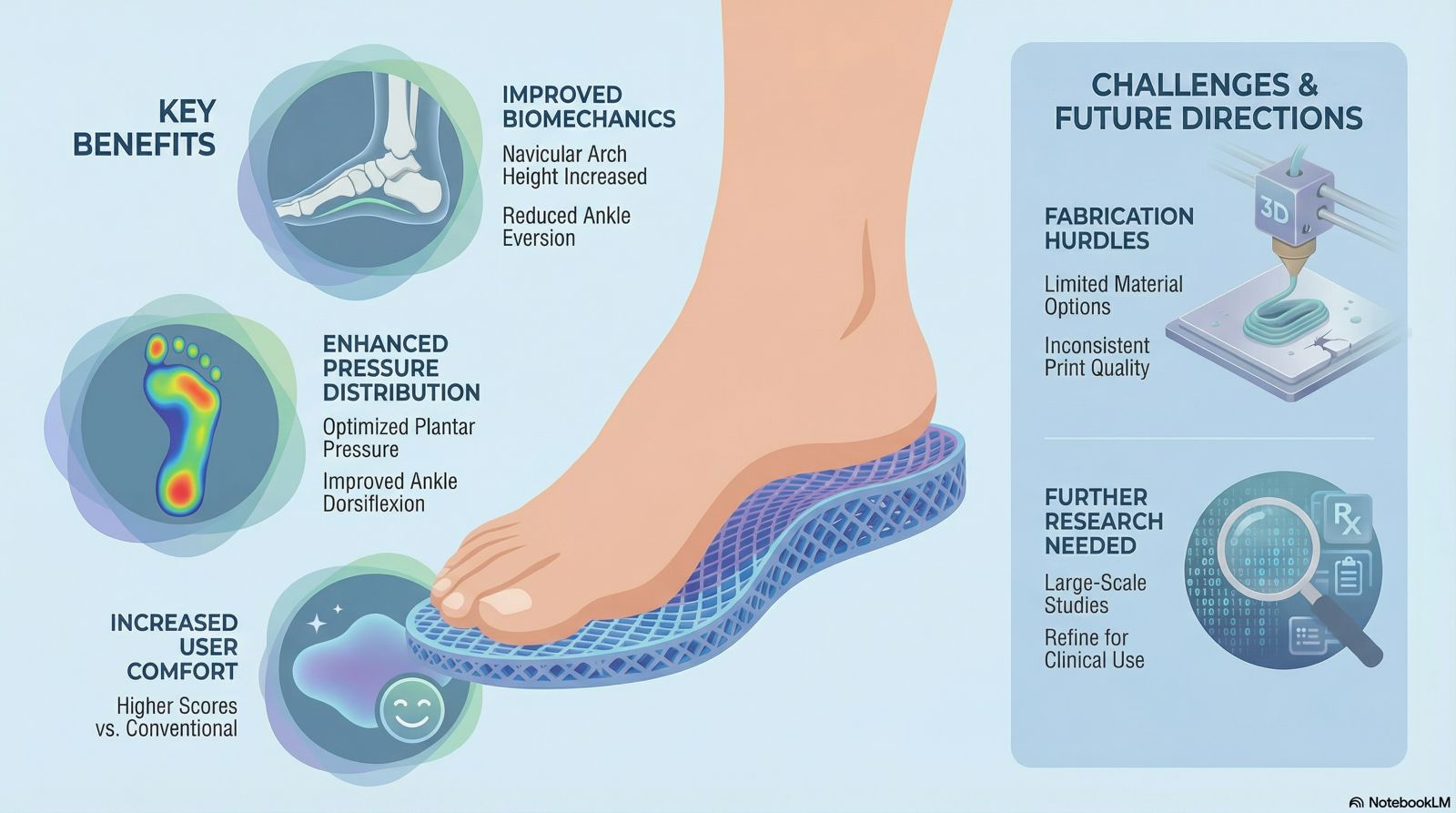
Flatfoot (pes planus), characterized by a reduced or absent medial arch, cause biomechanical disorders, pain and a risk of injury. Customized insoles are a key intervention, with the emergence of 3D printing fused deposition modelling (FDM) based on flexible materials such as thermoplastic polyurethane (TPU) and thermoplastic elastomer (THE). This systematic literature review, based on PRISMA guidelines and analysis of six Scopus studies, assesses the biomechanical and ergonomic properties of these insoles. The results show that flexible 3D printed inserts significantly improve biomechanics by increasing the height of the navicular arch, reducing excessive ankle joint eversion, increasing dorsiflexion and improving the distribution of plantar plate pressure. Regarding perceived comfort, evaluations using the Visual Analog Scale (VAS), the Likert scale and the American Orthopaedic Foot and Ankle Society (AOFAS) questionnaire consistently indicate improved user comfort over no insole or conventional option. Despite these advantages, challenges include limited material options, inconsistent print quality and technical fabrication problems. Further research is needed, especially large-scale studies, to resolve these problems and to improve the clinical use of the product. In conclusion, flexible inserts printed with FDM have the potential to improve both the biomechanical function and the perceived comfort of the footwear use.
Downloads
References
[2] A. Daryabor, T. Kobayashi, H. Saeedi, S. M. Lyons, N. Maeda, and S. S. Naimi, “Effect of 3D printed insoles for people with flatfeet: A systematic review,” 2023, Taylor and Francis Ltd. doi: 10.1080/10400435.2022.2105438.
[3] S. Jandova and R. Mendricky, “Benefits of 3D Printed and Customized Anatomical Footwear Insoles for Plantar Pressure Distribution,” 3D Print Addit Manuf, vol. 9, no. 6, 2022, doi: 10.1089/3dp.2021.0002.
[4] E. Bednarczyk, S. Sikora, A. Kossobudzka-Górska, K. Jankowski, and Y. Hernandez-Rodriguez, “Understanding flat feet: An in-depth analysis of orthotic solutions,” Journal of Orthopaedic Reports, vol. 3, no. 1, p. 100250, Mar. 2024, doi: 10.1016/j.jorep.2023.100250.
[5] M. Moeini, L. Yue, M. Begon, and M. Lévesque, “Surrogate optimization of a lattice foot orthotic,” Comput Biol Med, vol. 155, 2023, doi: 10.1016/j.compbiomed.2022.106376.
[6] C. Payne, “Cost benefit comparison of plaster casts and optical scans of the foot for the manufacture of foot orthoses,” MPH australasian Journal of podiatric Medicine, vol. 41, no. 412, 2007.
[7] Y. Wang, Q. Tan, F. Pu, D. Boone, and M. Zhang, “A Review of the Application of Additive Manufacturing in Prosthetic and Orthotic Clinics from a Biomechanical Perspective,” Engineering, vol. 6, no. 11, pp. 1258–1266, Nov. 2020, doi: 10.1016/j.eng.2020.07.019.
[8] O. Ciobanu, Y. Soydan, and S. Hızal, “CUSTOMIZED FOOT ORTHOSIS MANUFACTURED WITH 3D PRINTERS,” 2012.
[9] S. Hu et al., “Effect of orthotic insole on symptomatic flexible flatfoot in school-age children: Meta-analysis and 1-year follow-up study,” Biomedical Technology, vol. 7, pp. 63–70, Sep. 2024, doi: 10.1016/j.bmt.2024.08.001.
[10] R. B. Kristiawan, F. Imaduddin, D. Ariawan, Ubaidillah, and Z. Arifin, “A review on the fused deposition modeling (FDM) 3D printing: Filament processing, materials, and printing parameters,” 2021. doi: 10.1515/eng-2021-0063.
[11] Bs. Simon K. Spooner, PhD, “3D Orthotic Printing: Fad Or Game Changer? | Podiatry Today,” Journal PodiatryToday, vol. 29, no. 12, 2016.
[12] Y. Wang, W. Jiang, Y. Gan, Y. Yu, and K. Dai, “Clinical Observation of 3D Printing Technology in Insoles for Flexible Flatfoot Patients,” J Shanghai Jiaotong Univ Sci, vol. 26, no. 3, pp. 398–403, Jun. 2021, doi: 10.1007/s12204-021-2311-7.
[13] S. Shaikh, B. Jamdade, and A. Chanda, “Effects of Customized 3D-Printed Insoles in Patients with Foot-Related Musculoskeletal Ailments—A Survey-Based Study,” Prosthesis, vol. 5, no. 2, 2023, doi: 10.3390/prosthesis5020038.
[14] J. Pauk, J. Tolstoj-Sienkiewicz, M. Ihnatouski, T. Kuzmierowski, and E. Chojnowski, “Influence of insole materials on friction and ground reaction force during gait,” Journal of Friction and Wear, vol. 36, no. 4, pp. 319–323, Jul. 2015, doi: 10.3103/S1068366615040133.
[15] K. L. Yick and C. Y. Tse, “Textiles and other materials for orthopaedic footwear insoles,” in Handbook of Footwear Design and Manufacture, Elsevier, 2013, pp. 341–371. doi: 10.1533/9780857098795.4.341.
[16] W. T. Lo, K. L. Yick, S. P. Ng, and J. Yip, “New methods for evaluating physical and thermal comfort properties of orthotic materials used in insoles for patients with diabetes,” J Rehabil Res Dev, vol. 51, no. 2, pp. 311–324, 2014, doi: 10.1682/JRRD.2013.01.0012.
[17] H. Khakbaz et al., “3D printing of highly flexible, cytocompatible nanocomposites for thermal management,” J Mater Sci, vol. 56, no. 10, 2021, doi: 10.1007/s10853-020-05661-9.
[18] T. Finnegan, “Preventing discoloration in thermoplastic polyurethanes,” in Annual Technical Conference - ANTEC, Conference Proceedings, 2019.
[19] P. Chandramohan, M. S. Bala Santhosh, and R. Raghu, “Process Parameters Optimization Through Response Surface Methodology for Enhanced Strength of Additively Manufactured Thermoplastic Polyurethane Parts,” 2025, pp. 351–368. doi: 10.1007/978-981-97-6016-9_28.
[20] M. C. Chang and Y. J. Choo, “Comparative Efficacy of 3D-Printed Insoles in Managing Common Foot Conditions: A Review,” Medical Science Monitor, vol. 31, Jan. 2025, doi: 10.12659/MSM.947252.
[21] U. Kalita, B. Parameswaran, and N. K. Singha, “Thermoplastic Elastomers,” in Kirk-Othmer Encyclopedia of Chemical Technology, Wiley, 2022, pp. 1–39. doi: 10.1002/0471238961.2008051808151204.a01.pub3.
[22] G. Holden, “Thermoplastic Elastomers,” in Applied Plastics Engineering Handbook, Elsevier, 2024, pp. 97–113. doi: 10.1016/B978-0-323-88667-3.00020-5.
[23] R. Varma, “Meeting the design challenges of tomorrow’s healthcare industry with high-performance TPEs,” Rubber World, vol. 238, no. 3, 2008.
[24] G. Holden, “Thermoplastic Elastomers,” in Applied Plastics Engineering Handbook, Elsevier, 2017, pp. 91–107. doi: 10.1016/B978-0-323-39040-8.00005-5.
[25] B. L. Bermúdez-Bencomo et al., “Feasibility of Thermoplastic Elastomer in the Design of Pediatric Orthopedic Insoles by 3D Printing,” 2025, pp. 100–110. doi: 10.1007/978-3-031-89510-4_9.
[26] C. W. Burr and R. T. Vanderbilt, “Improved stabilization for TPEs,” Rubber World, vol. 247, no. 1, 2012.
[27] S. Liu, D. Wang, G. Guo, J. Zhang, J. Qiu, and A. Zhang, “Thermal‐Oxidative Aging Behavior and Factors of Polystyrene‐Based Thermoplastic Elastomers‐Based Automotive Interior Skin,” J Appl Polym Sci, vol. 142, no. 16, Apr. 2025, doi: 10.1002/app.56769.
[28] M. Danko, J. Sekac, E. Dzivakova, J. Zivcak, and R. Hudak, “3D Printing of Individual Running Insoles – A Case Study,” Orthop Res Rev, vol. 15, 2023, doi: 10.2147/ORR.S399624.
[29] R. Pranckutė, “Web of Science (WoS) and Scopus: the titans of bibliographic information in today’s academic world,” 2021. doi: 10.3390/publications9010012.
[30] J. F. Burnham, “Scopus database: A review,” 2006. doi: 10.1186/1742-5581-3-1.
[31] M. T. Diaz et al., “Evaluating recruitment methods for selection bias: A large, experimental study of hand biomechanics,” J Biomech, vol. 182, p. 112558, Mar. 2025, doi: 10.1016/j.jbiomech.2025.112558.
[32] T. Y. Moore and G. T. Clifton, “Jumping over fences: why field- and laboratory-based biomechanical studies can and should learn from each other,” 2023. doi: 10.1242/jeb.245284.
[33] S. A. Gonzalez-Blohm, J. J. Doulgeris, W. E. Lee, T. M. Shea, K. Aghayev, and F. D. Vrionis, “The current testing protocols for biomechanical evaluation of lumbar spinal implants in laboratory setting: A review of the literature,” 2015. doi: 10.1155/2015/506181.
[34] D. Knudson, “Confidence crisis of results in biomechanics research,” 2017. doi: 10.1080/14763141.2016.1246603.
[35] E. Hohmann et al., “Cadaveric Biomechanical Laboratory Research Can Be Quantitatively Scored for Quality With the Biomechanics Objective Basic Science Quality Assessment Tool: The BOBQAT Score,” Arthroscopy - Journal of Arthroscopic and Related Surgery, vol. 40, no. 8, 2024, doi: 10.1016/j.arthro.2024.01.003.
[36] D. C. Hartlen and D. S. Cronin, “Hypothesis Testing of Multivariate Biomechanical Responses using Statistical Parametric Mapping and Arc-Length Re-parameterization,” Ann Biomed Eng, vol. 53, no. 10, pp. 2536–2550, Oct. 2025, doi: 10.1007/s10439-025-03788-x.
[37] R. M. Carnahan and G. D. Brown, “The power and pitfalls of underpowered studies,” Pharmacotherapy: The Journal of Human Pharmacology and Drug Therapy, vol. 44, no. 9, pp. 698–700, Sep. 2024, doi: 10.1002/phar.4605.
[38] M. Davern, “Nonresponse Rates are a Problematic Indicator of Nonresponse Bias in Survey Research,” Health Serv Res, vol. 48, no. 3, pp. 905–912, Jun. 2013, doi: 10.1111/1475-6773.12070.
[39] K. W. Cheng et al., “A three-dimensional printed foot orthosis for flexible flatfoot: An exploratory biomechanical study on arch support reinforcement and undercut,” Materials, vol. 14, no. 18, 2021, doi: 10.3390/ma14185297.
[40] C. Y. Hsu, C. S. Wang, K. W. Lin, M. J. Chien, S. H. Wei, and C. S. Chen, “Biomechanical Analysis of the FlatFoot with Different 3D-Printed Insoles on the Lower Extremities,” Bioengineering, vol. 9, no. 10, 2022, doi: 10.3390/bioengineering9100563.
[41] B. Praewpipat, Y. Ehara, W. Kosorn, and N. Nampichai, “Biomechanical effect between conventional and 3-dimensional printed customized foot orthoses on medial longitudinal arch support and rearfoot angle in adults with flexible flatfeet,” Prosthet Orthot Int, 2024, doi: 10.1097/PXR.0000000000000383.
[42] Y. Cherni, G. Desmyttere, M. Hajizadeh, J. Bleau, C. Mercier, and M. Begon, “Effect of 3D printed foot orthoses stiffness on muscle activity and plantar pressures in individuals with flexible flatfeet: A statistical non-parametric mapping study,” Clinical Biomechanics, vol. 92, 2022, doi: 10.1016/j.clinbiomech.2021.105553.
[43] M. Davia-Aracil, J. J. Hinojo-Pérez, A. Jimeno-Morenilla, and H. Mora-Mora, “3D printing of functional anatomical insoles,” Comput Ind, vol. 95, 2018, doi: 10.1016/j.compind.2017.12.001.
[44] F. P. Camargo, D. R. Gomes, L. R. Alves, and C. E. Corrêa, “Development of polymer insole in additive manufacturing for people with plantar hyperhidrosis,” Disciplinarum Scientia - Ciências Naturais e Tecnológicas, vol. 25, no. 2, pp. 15–26, 2024, doi: 10.37779/nt.v25i2.4732.
[45] Y. Rao et al., “Effects of peak ankle dorsiflexion angle on lower extremity biomechanics and pelvic motion during walking and jogging,” Front Neurol, vol. 14, 2023, doi: 10.3389/fneur.2023.1269061.
[46] S. Park, J.-H. Jung, S. Lei, E.-Y. Jung, and H.-Y. Cho, “3D-Printed Customized Arch-Support Insoles Improve Gait Mechanics and Ankle Alignment in Young Adults with Functional Flat Foot During Uphill Walking,” Medicina (B Aires), vol. 61, no. 2, p. 281, Feb. 2025, doi: 10.3390/medicina61020281.
[47] R. Xu et al., “Comparative study of the effects of customized 3D printed insole and prefabricated insole on plantar pressure and comfort in patients with symptomatic flatfoot,” Medical Science Monitor, vol. 25, 2019, doi: 10.12659/MSM.916975.
[48] X. Hu et al., “Microwave Radiation Assisted Construction of Fused Deposition Modeling 3D Printing Flexible Sensors,” Macromol Chem Phys, vol. 225, no. 24, Dec. 2024, doi: 10.1002/macp.202400284.
[49] Q. Deng et al., “Topological Structure and Biomechanics of Three-Dimensional Printed Height Increasing Insoles for Leg Length Discrepancy,” Journal of Medical Biomechanics, vol. 37, no. 1, pp. 45–51, Feb. 2022.
[50] M. Yarwindran, N. Azwani Sa, M. Ibrahim, R. Periyasamy, T. Hussein Onn Malaysia, and B. Pahat Johor, “THERMOPLASTIC ELASTOMER INFILL PATTERN IMPACT ON MECHANICAL PROPERTIES 3D PRINTED CUSTOMIZED ORTHOTIC INSOLE,” vol. 11, no. 10, 2016, [Online]. Available: www.arpnjournals.com
[51] K. Han, K. Bae, N. Levine, J. Yang, and J.-S. Lee, “Biomechanical Effect of Foot Orthoses on Rearfoot Motions and Joint Moment Parameters in Patients with Flexible Flatfoot,” Medical Science Monitor, vol. 25, pp. 5920–5928, Aug. 2019, doi: 10.12659/MSM.918782.
[52] H. R. Branthwaite, C. J. Payton, and N. Chockalingam, “The effect of simple insoles on three-dimensional foot motion during normal walking,” Clinical Biomechanics, vol. 19, no. 9, pp. 972–977, Nov. 2004, doi: 10.1016/j.clinbiomech.2004.06.009.
[53] B. L. Costa et al., “Is there a dose-response of medial wedge insoles on lower limb biomechanics in people with pronated feet during walking and running?,” Gait Posture, vol. 90, pp. 190–196, Oct. 2021, doi: 10.1016/j.gaitpost.2021.09.163.
[54] Y. Tang et al., “Effect of Custom-Made Orthotic Insoles on Lower Limb Biomechanics in Children with Flexible Flat Feet,” Leather and Footwear Journal, vol. 23, no. 2, pp. 83–92, Jun. 2023, doi: 10.24264/lfj.23.2.2.
[55] G. Desmyttere, M. Hajizadeh, J. Bleau, S. Leteneur, and M. Begon, “Anti-pronator components are essential to effectively alter lower-limb kinematics and kinetics in individuals with flexible flatfeet,” Clinical Biomechanics, vol. 86, 2021, doi: 10.1016/j.clinbiomech.2021.105390.
[56] J. Zuñiga et al., “Development of 3D-Printed Orthopedic Insoles for Patients with Diabetes and Evaluation with Electronic Pressure Sensors,” Designs (Basel), vol. 6, no. 5, 2022, doi: 10.3390/designs6050095.
[57] Y.-K. Kim and J.-Y. Joo, “Effects of Custom-Made 3d Printed Insoles for Flat-Foot People on Gait Parameters: A Preliminary Study,” 35th Conference of the International Society of Biomechanics in Sports, no. Figure 1, 2017.
[58] K. O’Leary, K. A. Vorpahl, and B. Heiderscheit, “Effect of cushioned insoles on impact forces during running,” J Am Podiatr Med Assoc, vol. 98, no. 1, 2008, doi: 10.7547/0980036.
[59] J. Jin et al., “Optimization Design of the Inner Structure for a Bioinspired Heel Pad with Distinct Cushioning Property,” Bioengineering, vol. 10, no. 1, 2023, doi: 10.3390/bioengineering10010049.
[60] N. Willemstein, S. Sridar, H. van der Kooij, and A. Sadeghi, “A feasibility study on using soft insoles for estimating 3D ground reaction forces with incorporated 3D-printed foam-like sensors,” Wearable Technologies, vol. 6, p. e3, Jan. 2025, doi: 10.1017/wtc.2024.23.
[61] Y. Hosseini, N. Farahpour, and M. Motamedzade, “The effects of antipronation insole on ground reaction force, impulse and loading rate during one leg landing,” Scientific Journal of Kurdistan University of Medical Sciences, vol. 20, no. 6, 2016.
[62] K. W. Lin et al., “Biomechanical evaluation and strength test of 3D-printed foot orthoses,” Appl Bionics Biomech, vol. 2019, 2019, doi: 10.1155/2019/4989534.
[63] E. C. Matthias, H. A. Banwell, and J. B. Arnold, “Methods for assessing footwear comfort: a systematic review,” 2021. doi: 10.1080/19424280.2021.1961879.
[64] M. Ortiz, P. Vicente, E. Ianez, E. Montiel, and J. M. Azorin, “Assessing footwear comfort by electroencephalography analysis,” IEEE Access, vol. 9, 2021, doi: 10.1109/ACCESS.2021.3115179.
[65] A. K. Özgün, H. K. Sezer, S. Alsancak, and I. Şahin, “The Effect of 3D-Printed Custom Insoles on Plantar Pressure for Obese Individual,” JPO Journal of Prosthetics and Orthotics, vol. 36, no. 4, pp. e91–e97, Oct. 2024, doi: 10.1097/JPO.0000000000000526.
[66] F. Simi, G. M. Fortunato, F. Diana, J. Gai, and C. De Maria, “An Algorithm for Coding an Additive Manufacturing File from the Pressure Distribution of a Baropodometric Board for 3D Printing Customised Orthopaedic Insoles,” Computation, vol. 12, no. 9, p. 184, Sep. 2024, doi: 10.3390/computation12090184.
[67] B. Adak, S. Mukhopadhyay, and S. Kumar, “Smart/functional textiles and fashion products enabled by 3D and 4D printing,” in Smart and Functional Textiles, 2023. doi: 10.1515/9783110759747-017.
[68] D. He and Z. Li, “3D Printed Flexible Energy Devices,” in Smart and Flexible Energy Devices, Boca Raton: CRC Press, 2022, pp. 99–117. doi: 10.1201/9781003186755-6.
[69] M. C. Iacob, D. Popescu, and T. G. Alexandru, “PRINTABILITY OF THERMOPLASTIC POLYURETHANE WITH LOW SHORE A HARDNESS IN THE CONTEXT OF CUSTOMIZED INSOLES PRODUCTION,” UPB Scientific Bulletin, Series D: Mechanical Engineering, vol. 86, no. 2, pp. 95–106, 2024.
[70] N. Aliheidari, C. Hohimer, and A. Ameli, “3D-printed conductive nanocomposites for liquid sensing applications,” in ASME 2017 Conference on Smart Materials, Adaptive Structures and Intelligent Systems, SMASIS 2017, 2017. doi: 10.1115/SMASIS2017-3855.
[71] Md. H. Ali, S. Trubayev, and E. Shehab, “3D printed large-scale insole and its printing challenges,” 2023, p. 050049. doi: 10.1063/5.0110272.
[72] H. Kim, S. Park, and I. Lee, “Additive manufacturing of smart insole by direct printing of pressure sensitive material,” Journal of Mechanical Science and Technology, vol. 33, no. 12, 2019, doi: 10.1007/s12206-019-1101-8.
[73] M. Ntagios and R. Dahiya, “3D Printed Soft and Flexible Insole With Intrinsic Pressure Sensing Capability,” IEEE Sens J, vol. 23, no. 20, 2023, doi: 10.1109/JSEN.2022.3179233.
Article Sidebar

Article Details

This work is licensed under a Creative Commons Attribution-NonCommercial-ShareAlike 4.0 International License.
Copyright Ownership
- Authors who publish their articles in Jurnal Optimasi Sistem Industri (JOSI) retain full copyright of their work.
- JOSI does not require authors to transfer their copyright to the journal or its publisher, Universitas Andalas. The authors grant JOSI a license for first publication.
All articles published in Jurnal Optimasi Sistem Industri (JOSI) are licensed under the Creative Commons Attribution-NonCommercial-ShareAlike 4.0 International (CC BY-NC-SA 4.0) license.
This means that users are free to:
- Share — copy and redistribute the material in any medium or format.
- Adapt — remix, transform, and build upon the material.
Under the following terms:
- Attribution (BY): You must give appropriate credit to the author(s) and JOSI as the original source of publication (including the article title, author(s) names, journal name, volume, issue, page numbers, year, and DOI), provide a link to the CC BY-NC-SA 4.0 license, and indicate if changes were made. You may do so in any reasonable manner, but not in any way that suggests the licensor endorses you or your use.
- NonCommercial (NC): You may not use the material for commercial purposes.
- ShareAlike (SA): If you remix, transform, or build upon the material, you must distribute your contributions under the same CC BY-NC-SA 4.0 license as the original.
A link to the full license text should also be provided: https://creativecommons.org/licenses/by-nc-sa/4.0/
Xiao Liu, Deakin University
School of Information Technology
Ali Zolfagharian, Deakin University
School of Engineering