
Design of Luxury Train Seat Integrating Emotional Perception and Local Wisdom Approaches
Main Article Content
Keywords
emotional preferences, kansei engineering, local wisdom, QTT1, batik motifs
Abstract
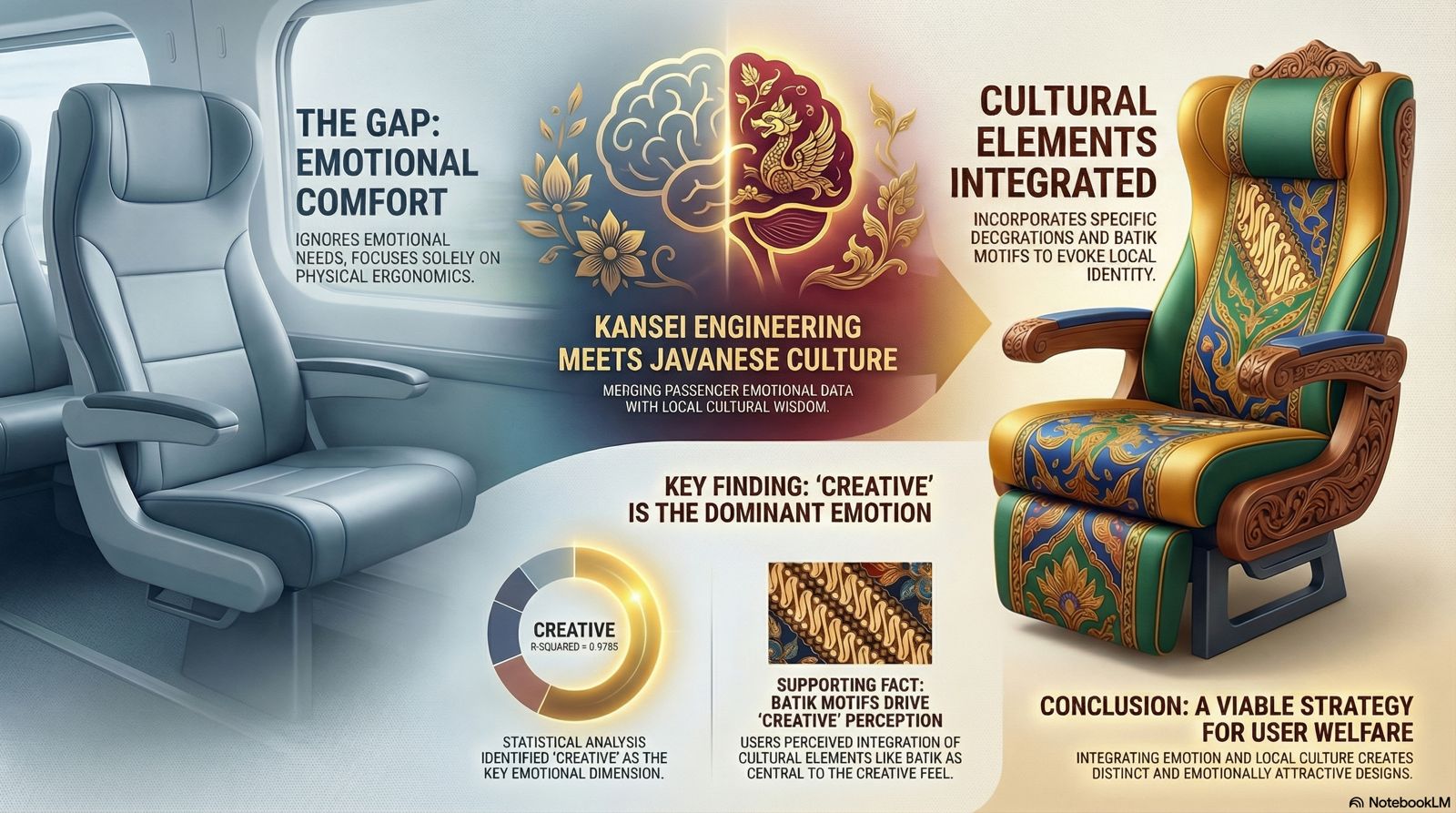
Although the physical ergonomics of seat design have been extensively studied, emotional comfort is still largely overlooked, especially in public transport. This study addresses this gap by incorporating passengers' emotional perceptions into the design of luxury train seats, in response to documented user discomfort which transcends physical dimensions. The aim was to design seats based on the emotional needs of users and the principles of Kansei engineering, incorporating elements of Javanese cultural values as a form of local wisdom. Emotional responses were captured using Kansei words derived from user interviews, online reviews, and from the expertise of local practitioners. The designs included batik and Javanese decorations. A statistical analysis using Quantitative Theory of Type I (QTT1) identified design elements corresponding to semantic differences between Kansei words. Analysis revealed that the dominant emotional dimension is creative, as indicated by the highest multiple of R-squared 0.9785. This dimension has been operationalized in 14 concrete design elements of the proposed seating concept. The innovative use of batik motifs on the seat backrests was a distinctive feature and underlined the fact that users perceived cultural integration as central to the creative dimension. The study concluded that the integration of emotional perception, represented by the creative dimension, and local wisdom, represented by the batik elements, is a viable strategy for the design of culturally distinct and emotionally attractive luxury train seats. It shows that the culturally rooted approach of Kansei Engineering contributes to the welfare of users.
Downloads
References
[2] R. Verma, S. Ghosh, M. Saketh, N. Ganguly, B. Mitra, and S. Chakraborty, “Comfride: a smartphone based system for comfortable public transport recommendation,” in Proceedings of the 12th ACM Conference on Recommender Systems, in RecSys ’18. New York, NY, USA: Association for Computing Machinery, 2018, pp. 181–189. doi: 10.1145/3240323.3240359.
[3] ppid, “Report of customer satisfaction survey,” Bandung, Oct. 2022. Accessed: Aug. 16, 2025. [Online]. Available: ppid.kai.id
[4] N. Ahmadpour, J.-M. Robert, and G. Lindgaard, “Aircraft passenger comfort experience: Underlying factors and differentiation from discomfort,” Appl Ergon, vol. 52, pp. 301–308, 2016, doi: https://doi.org/10.1016/j.apergo.2015.07.029.
[5] A. Kruithof, V. Visch, P. Vink, and O. Pedgley, “Comfort Design Through Music and Emotion: Effects of Passengers’ Activities on Comfort,” in AHFE International Conference, AHFE Open Access, 2020. doi: http://doi.org/10.54941/ahfe100368.
[6] D. Prasetyo, N. Ramadhani, M. Hariadi, and I. Rizky Mutiaz, “Lighting Dynamics for Emotional Perception: A Technology-Driven Virtual Simulation Approach,” Engineering, Technology & Applied Science Research, vol. 15, no. 2, pp. 22196–22202, Apr. 2025, doi: 10.48084/etasr.10434.
[7] V. A. Zeithaml, K. Verleye, I. Hatak, M. Koller, and A. Zauner, “Three Decades of Customer Value Research: Paradigmatic Roots and Future Research Avenues,” J Serv Res, vol. 23, no. 4, pp. 409–432, Aug. 2020, doi: 10.1177/1094670520948134.
[8] Ó. López, C. Murillo, and A. González, “Systematic literature reviews in kansei engineering for product design—a comparative study from 1995 to 2020†,” Sensors, vol. 21, no. 19, Oct. 2021, doi: 10.3390/s21196532.
[9] K. S. Patel, “Exploring the luxury train experience: A case study of the TranzAlpine train in partial fulfilment of the requirements for the degree of Master of International Tourism Management (MITM) 2024 School of Hospitality and Tourism ii,” Auckland University of Technology, Auckland, New Zealand, 2024.
[10] D. K. Yohanny, L. Purwaningrum, and A. Mulyono, “Research on Affective Ergonomics of User Preferences towards Train Compartment Design,” SHS Web of Conferences, vol. 189, p. 01020, 2024, doi: 10.1051/shsconf/202418901020.
[11] N. Arya, A. Gauthama, and S. Riyadi, “Consumers’ Visual Perception of First and Second Generation Luxury Sleeper Train Passenger’ Seats,” in Proc. 2nd ITB Graduate School Conf.: Strengthening Multidisciplinary Research to Enhance its Impact on Society, Bandung, Indonesia: ITB, Jul. 2022.
[12] R. Ginting and A. Y. Ali, “Improved Kansei Engineering with Quality Function Deployment Integration: A Comparative Case Study,” IOP Conf Ser Mater Sci Eng, vol. 505, no. 1, p. 012092, 2019, doi: 10.1088/1757-899X/505/1/012092.
[13] A. M. Lokman, A. A. Awang, A. R. Omar, and N. A. S. Abdullah, “The integration of quality function deployment and Kansei Engineering: An overview of application,” AIP Conf Proc, vol. 1705, no. 1, p. 020004, Feb. 2016, doi: 10.1063/1.4940252.
[14] R. Ginting, A. Ishak, A. Fauzi Malik, and M. R. Satrio, “Integration of Kansei Engineering and Quality Function Deployment (QFD) for Product Development : A Literature Review,” IOP Conf Ser Mater Sci Eng, vol. 1003, no. 1, p. 012020, 2020, doi: 10.1088/1757-899X/1003/1/012020.
[15] J. Chen, “An architecture-oriented kansei engineering system for innovative long chi inkstone design,” Heliyon, vol. 9, no. 12, Dec. 2023, doi: 10.1016/j.heliyon.2023.e23015.
[16] X. Zhao, S. Azim Sharudin, and H.-L. Lv, “A novel product shape design method integrating Kansei engineering and whale optimization algorithm,” Advanced Engineering Informatics, vol. 62, p. 102847, 2024, doi: https://doi.org/10.1016/j.aei.2024.102847.
[17] M. Ushada and T. Okayama, “Kansei Engineering for Quantification of Indigenous Knowledges in Agro-industrial Technology,” KnE Life Sciences, vol. 3, no. 3, p. 72, Jan. 2016, doi: 10.18502/kls.v3i3.380.
[18] N. Shaari, “Indigenous Knowledge Creativity in Batik Cultural Product based on Kansei,” in International Conference on Social Sciences and Humanities (ICSSH’15), Bali, Indonesia: International Institute of Engineers, May 2015. doi: 10.15242/icehm.ed0515056.
[19] X. Zhang and K.-H. Wen, “A Model Process of Integrating Context of Local Culture for Pre-Development Stage in the Design of Cultural and Creative Products—Using Macao’s Historical Buildings as an Example,” Sustainability, vol. 12, no. 15, 2020, doi: 10.3390/su12156263.
[20] E. S. Marizar, Kursi kekuasaan Jawa. Yogyakarta: Narasi, 2013.
[21] D. Gumulya, J. T. Purba, E. S. Hariandja, and R. Pramono, “Cultural Product Design as a Key Strategy for Innovation Capability Development: Evidence from Indonesian Creative Social Enterprises,” Archives of Design Research, vol. 36, no. 1, pp. 21–40, 2023, doi: 10.15187/ADR.2023.02.36.1.21.
[22] J.-N. Kapferer, “The future of luxury: Challenges and opportunities,” Journal of Brand Management, vol. 21, no. 9, pp. 716–726, 2014, doi: 10.1057/bm.2014.32.
[23] B. Camburn et al., “Design prototyping methods: State of the art in strategies, techniques, and guidelines,” Design Science, vol. 3, 2017, doi: 10.1017/dsj.2017.10.
[24] S. SCHÜTTE et al., “Kansei for the Digital Era,” International Journal of Affective Engineering, vol. 23, no. 1, pp. 1–18, 2024, doi: 10.5057/ijae.IJAE-D-23-00003.
[25] Z. Li, Z. G. Tian, J. W. Wang, W. M. Wang, and G. Q. Huang, “Dynamic mapping of design elements and affective responses: a machine learning based method for affective design,” Journal of Engineering Design, vol. 29, no. 7, pp. 358–380, Jul. 2018, doi: 10.1080/09544828.2018.1471671.
[26] M. Nagamachi, “Kansei/Affective Engineering and History of Kansei/Affective Engineering in the World,” in KANSEI/AFFECTIVE ENGINEERING, M. NAGAMACHI, Ed., London: CRC Press Taylor & Francis Group, 2011, ch. 1, pp. 1–12.
[27] M. A. Bujang, E. D. Omar, D. H. P. Foo, and Y. K. Hon, “Sample size determination for conducting a pilot study to assess reliability of a questionnaire,” Restor Dent Endod, vol. 49, no. 1, pp. e3-, Jan. 2024, doi: 10.5395/rde.2024.49.e3.
[28] J. C. F. Winter, D. Dodou, and P. A. Wieringa, “Exploratory Factor Analysis With Small Sample Sizes,” Multivariate Behav Res, vol. 44, no. 2, 2009.
[29] A. M. Lokman, A. F. Harun, N. L. Nor, and M. Nagamachi, “Website affective evaluation: Analysis of differences in evaluations result by data population,” Lecture Notes in Computer Science (including subseries Lecture Notes in Artificial Intelligence and Lecture Notes in Bioinformatics), vol. 5619 LNCS, pp. 643–652, 2009, doi: 10.1007/978-3-642-02806-9_75.
[30] C. J. El Zouki, A. Chahine, E. Ghadban, F. Harb, J. El-Eid, and D. El Khoury, “Exploratory analysis of factors influencing hospital preferences among the Lebanese population: a cross-sectional study,” BMJ Open, vol. 14, no. 11, Nov. 2024, doi: 10.1136/bmjopen-2024-085727.
[31]C.-C. Liang, Y.-H. Lee, C.-H. Ho, and K.-H. Chen, “Investigating vehicle interior designs using models that evaluate user sensory experience and perceived value,” Artificial Intelligence for Engineering Design, Analysis and Manufacturing, vol. 34, no. 3, pp. 401–420, 2020, doi: DOI: 10.1017/S0890060419000246.
[32] W. Song, X. Xie, W. Huang, and Q. Yu, “The Design of Automotive Interior for Chinese Young Consumers Based on Kansei Engineering and Eye-Tracking Technology,” Applied Sciences, vol. 13, no. 19, 2023, doi: 10.3390/app131910674.
[33] S. Yardım and O. Pedgley, “Design considerations for automotive HMI and interiors,” International Journal of Design, vol. 17, no. 2, pp. 45–66, 2023.
[34] X. Zhang and K.-H. Wen, “A Model Process of Integrating Context of Local Culture for Pre-Development Stage in the Design of Cultural and Creative Products—Using Macao’s Historical Buildings as an Example,” Sustainability, vol. 12, no. 15, 2020, doi: 10.3390/su12156263.
Article Sidebar

Article Details

This work is licensed under a Creative Commons Attribution-NonCommercial-ShareAlike 4.0 International License.
Copyright Ownership
- Authors who publish their articles in Jurnal Optimasi Sistem Industri (JOSI) retain full copyright of their work.
- JOSI does not require authors to transfer their copyright to the journal or its publisher, Universitas Andalas. The authors grant JOSI a license for first publication.
All articles published in Jurnal Optimasi Sistem Industri (JOSI) are licensed under the Creative Commons Attribution-NonCommercial-ShareAlike 4.0 International (CC BY-NC-SA 4.0) license.
This means that users are free to:
- Share — copy and redistribute the material in any medium or format.
- Adapt — remix, transform, and build upon the material.
Under the following terms:
- Attribution (BY): You must give appropriate credit to the author(s) and JOSI as the original source of publication (including the article title, author(s) names, journal name, volume, issue, page numbers, year, and DOI), provide a link to the CC BY-NC-SA 4.0 license, and indicate if changes were made. You may do so in any reasonable manner, but not in any way that suggests the licensor endorses you or your use.
- NonCommercial (NC): You may not use the material for commercial purposes.
- ShareAlike (SA): If you remix, transform, or build upon the material, you must distribute your contributions under the same CC BY-NC-SA 4.0 license as the original.
A link to the full license text should also be provided: https://creativecommons.org/licenses/by-nc-sa/4.0/




Funding data
-
Kementerian Pendidikan, Kebudayaan, Riset, dan Teknologi,Kementerian Pendidikan, Kebudayaan, Riset, dan Teknologi
Grant numbers 086/E5/PG.02.00.PL/2024